Sustainable Surveying Vancouver: Green Building Documentation
Vancouver's construction industry is operating under increasing environmental pressure. The City's Climate Emergency Action Plan, the Vancouver Building By-law (VBBL), and aggressive 2030 zero-emissions targets are reshaping how buildings are designed, renovated,…
Vancouver's construction industry is operating under increasing environmental pressure. The City's Climate Emergency Action Plan, the Vancouver Building By-law (VBBL), and aggressive 2030 zero-emissions targets are reshaping how buildings are designed, renovated, and documented.
Sustainability is no longer limited to materials and mechanical systems. It now begins at the measurement stage.
Sustainable surveying in Vancouver represents a shift from analog, error-prone documentation toward high-precision digital capture that reduces waste, minimizes carbon emissions, and supports green building compliance. For developers, architects, contractors, and property owners, accurate data is now a sustainability tool.
What Is Sustainable Surveying?
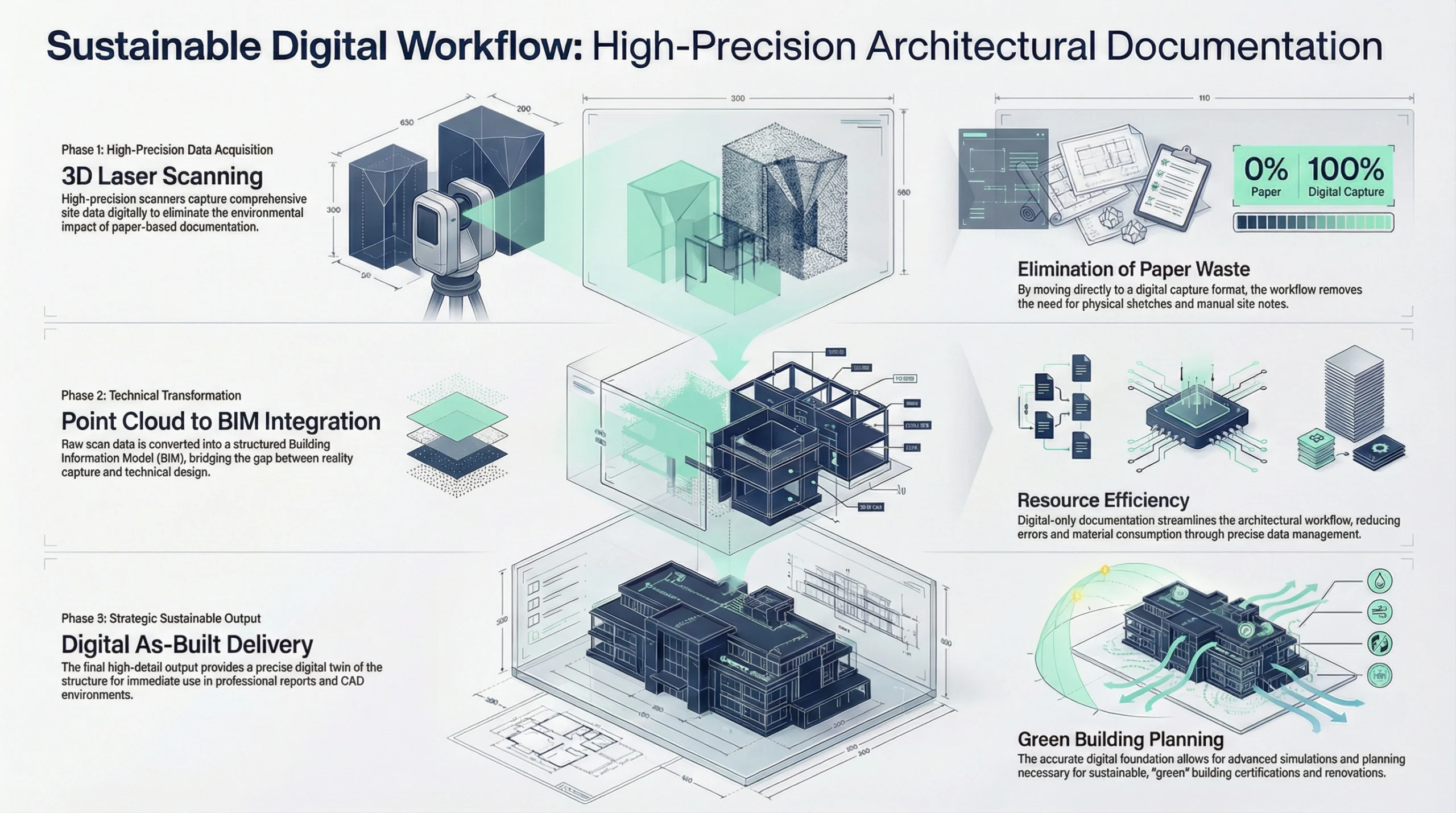
Sustainable surveying is the use of low-impact, digital-first measurement technologies – primarily 3D laser scanning and LiDAR – to document buildings and sites with minimal environmental disruption.
Traditional surveying often involves:
- Multiple return site visits
- Manual measurement errors
- Paper-heavy workflows
- Physical access equipment and disruption
Modern sustainable surveying replaces this with:
- Non-contact LiDAR scanning
- High-density point cloud capture
- Digital deliverables (CAD, BIM, area reports)
- Remote collaboration
The environmental benefit is twofold: fewer site trips and fewer construction errors.
Accuracy as a Carbon Reduction Strategy
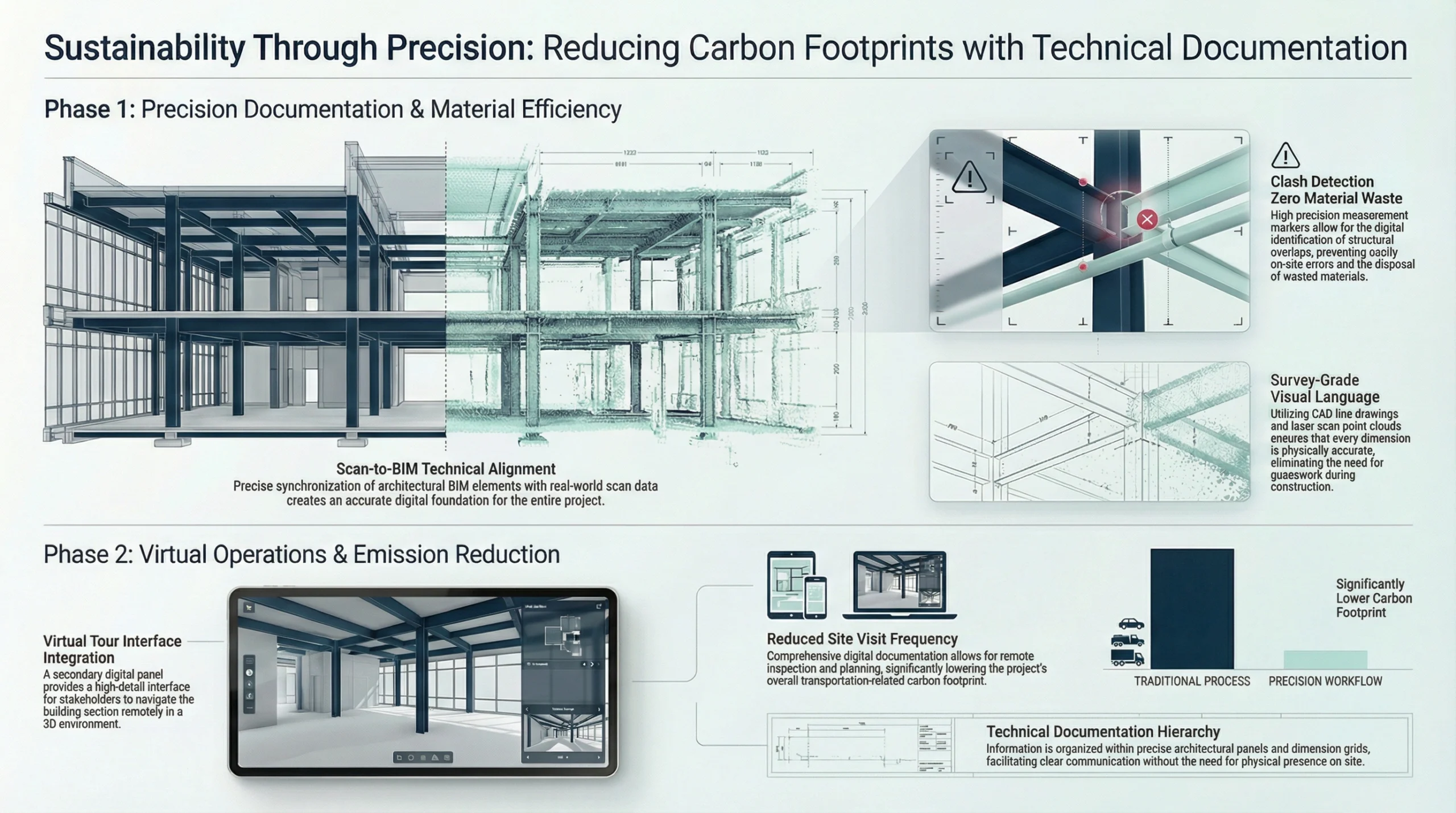
In construction, inaccuracy equals waste.
Every incorrect dimension leads to:
- Reordered materials
- Demolition and rework
- Increased embodied carbon
- Extended project timelines
3D laser scanning captures millions of data points in a single visit, producing accurate floor plans and digital twins that eliminate guesswork.
When contractors fabricate millwork, steel, glazing, or mechanical components based on verified measurements, materials fit the first time. That precision directly reduces landfill waste and embodied carbon.
Supporting Vancouver's 2030 Zero-Emissions Goals
The City of Vancouver aims to:
- Achieve zero emissions in new buildings by 2030
- Dramatically reduce emissions from existing building stock
Meeting these targets requires accurate documentation of existing conditions.
Deep Energy Retrofits
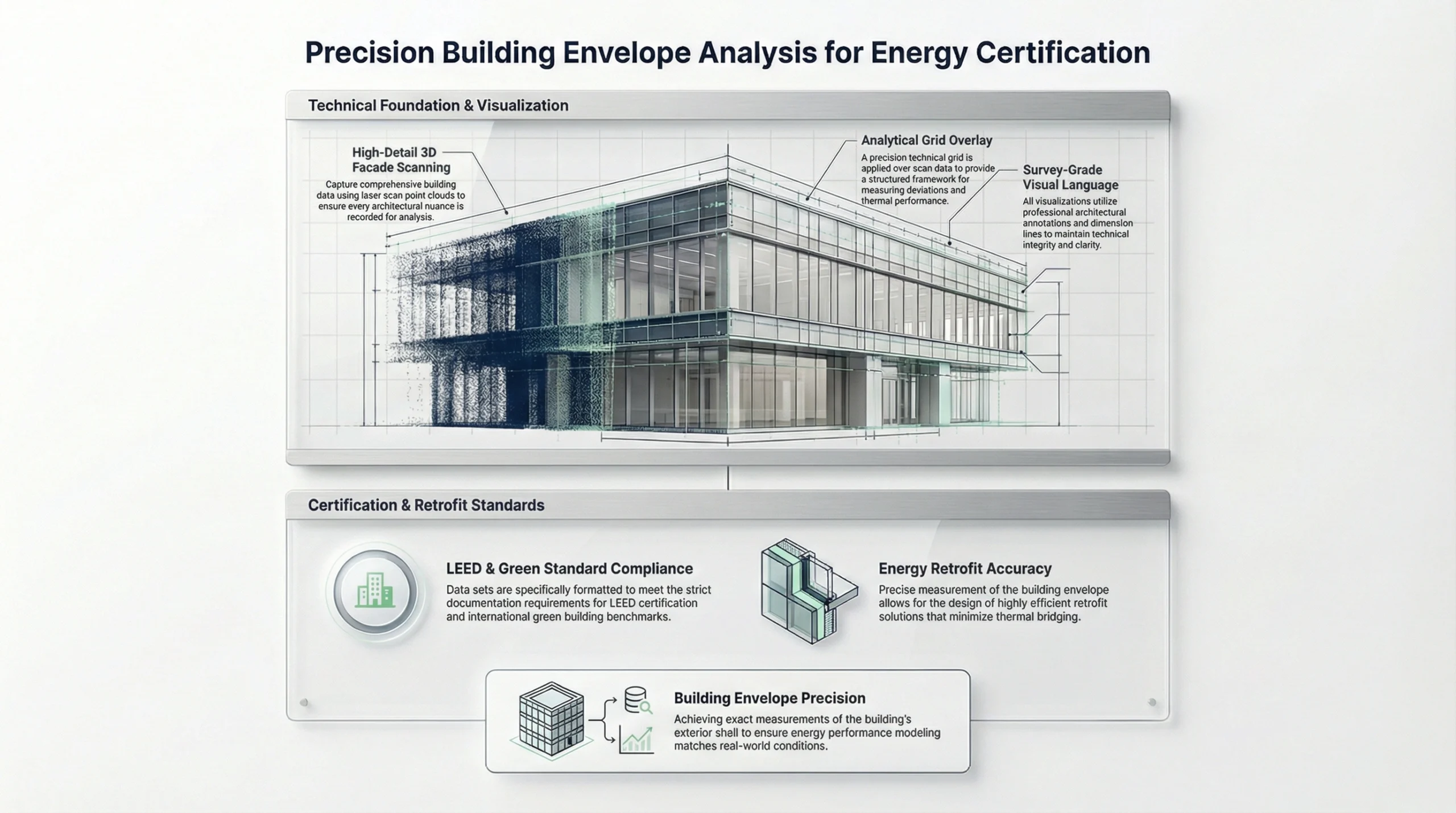
Retrofitting older buildings requires exact knowledge of:
- Envelope geometry
- Slab edges
- Thermal bridge locations
- Window openings
- Roof profiles
3D laser scanning provides the geometric accuracy required for energy modeling and retrofit planning.
Without reliable as-built data, performance gaps emerge between design and constructed reality.
Embodied Carbon and Material Efficiency
Embodied carbon is generated during:
- Manufacturing
- Transportation
- Installation
- Replacement due to errors
If inaccurate surveys cause materials to be replaced or modified, the carbon impact doubles.
Sustainable surveying in Vancouver reduces this risk by ensuring contractor estimates and material procurement are based on verified dimensions.
Precision reduces rework. Reduced rework lowers embodied emissions.
How 3D Laser Scanning Reduces Environmental Impact
1. Fewer Site Visits
Traditional workflows often require:
- Initial measurement visit
- Follow-up visits to confirm missed dimensions
- Additional coordination visits
A single comprehensive scan captures complete spatial data. The project team can revisit the site virtually through the point cloud or BIM model.
Fewer vehicle trips mean lower operational carbon emissions.
2. Reduced Site Disruption
Laser scanning is non-contact and non-invasive. It requires:
- Minimal physical intrusion
- No demolition
- No surface damage
This is particularly important in:
- Occupied buildings
- Heritage structures
- Sensitive ecological sites
3. Digital Twin for Long-Term Asset Management
The output of sustainable surveying is often a digital twin – a precise virtual replica of the building.
Digital twins support:
- Lifecycle maintenance planning
- Energy monitoring integration
- Space optimization
- Future retrofit planning
Extending a building's usable life is one of the most effective carbon reduction strategies available.
LEED and Green Building Documentation in BC
For developers pursuing LEED certification, defensible documentation is mandatory.
Sustainable surveying supports:
- Building Life-Cycle Impact Reduction credits
- Accurate site analysis
- Envelope verification
- Indoor environmental quality coordination
Scan-to-BIM workflows embed measurable data directly into the model, allowing energy consultants and engineers to work from verified geometry.
In a regulatory environment like Vancouver's, documentation accuracy directly affects compliance.
BOMA Standards and Space Optimization
In commercial real estate, sustainability also means maximizing existing space before building new.
Laser-based measurement allows:
- BOMA-compliant area calculations
- Accurate rentable area verification
- Identification of underutilized square footage
Optimizing existing assets reduces pressure for new construction, which carries significant embodied carbon.
Heritage Conservation and Adaptive Reuse
Vancouver's heritage inventory represents embodied carbon already invested decades ago.
Demolition wastes that carbon.
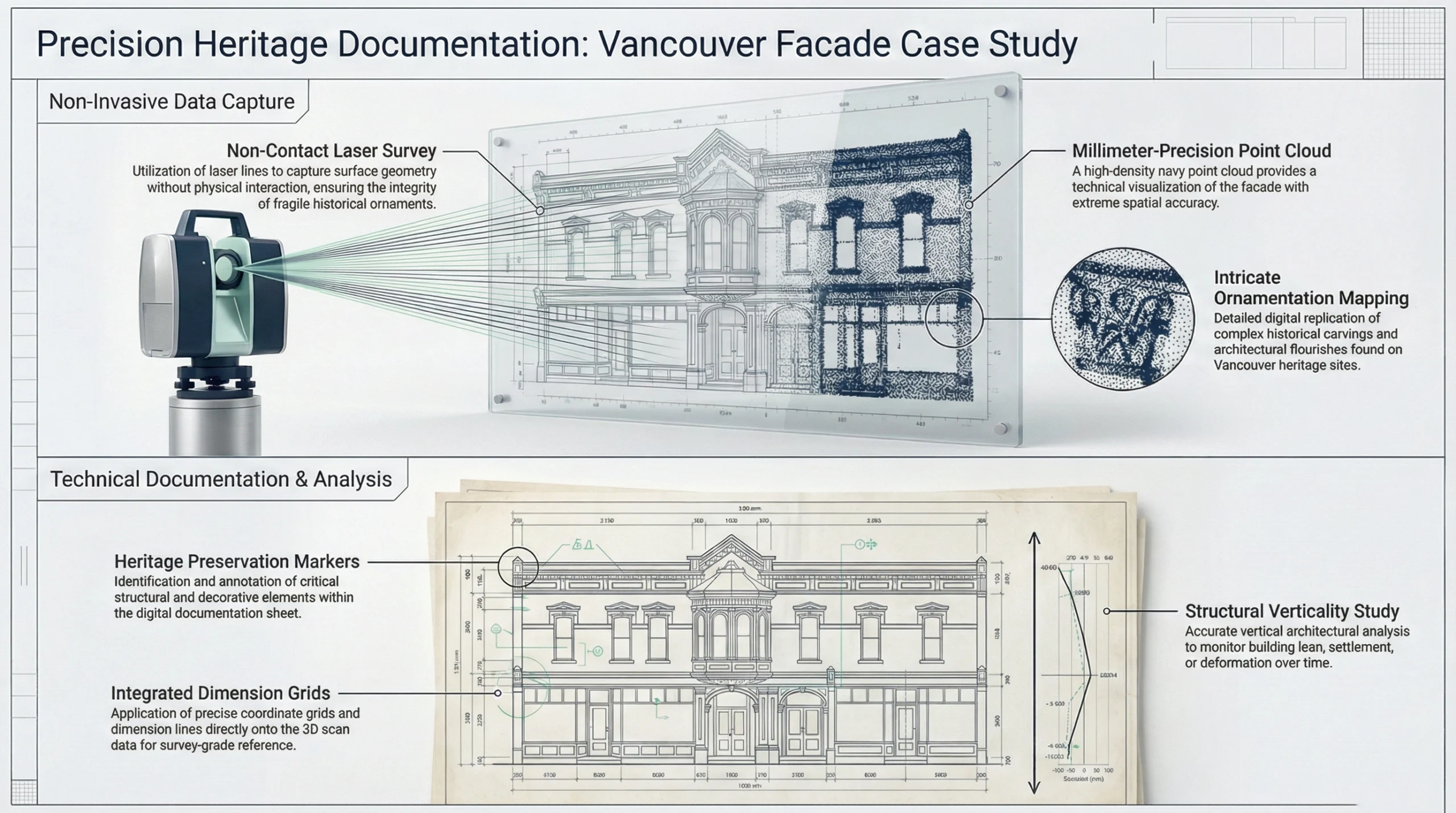
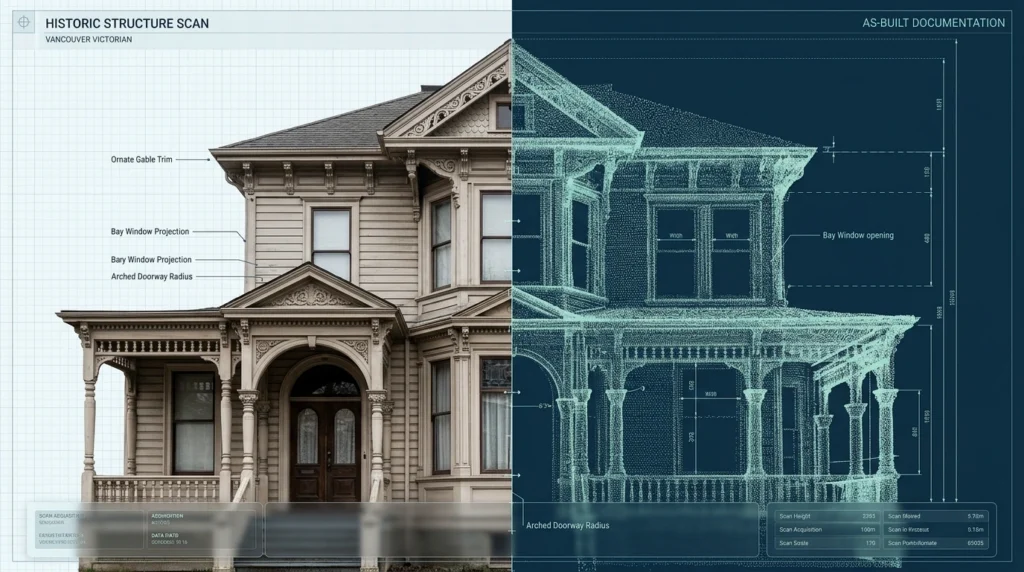
Sustainable surveying enables adaptive reuse by documenting complex, irregular structures without invasive measurement methods.
3D scanning can capture:
- Warped walls
- Uneven floors
- Ornamental facades
- Historical detailing
This precision encourages retention over demolition.
The greenest building is often the one that already exists.
Modern Tools for Eco-Friendly Measuring in Greater Vancouver
LiDAR and Terrestrial Laser Scanning
Millimeter-accurate interior and exterior capture with minimal disruption.
Drone-Based Surveying
Ideal for roofs, facades, and large sites without scaffolding or heavy access equipment.
Scan-to-BIM Workflows
Conversion of raw point clouds into intelligent 3D models for energy analysis, retrofit coordination, and lifecycle planning.
These tools collectively reduce field time, minimize rework, and support long-term sustainability goals.
Business Case for Sustainable Surveying
Environmental responsibility must align with financial logic.
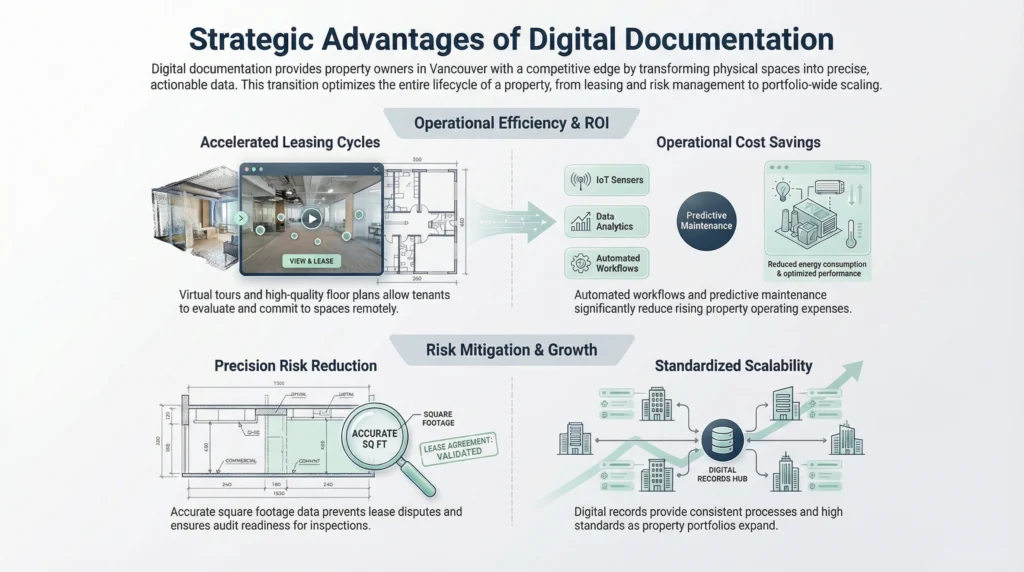
Sustainable surveying in Vancouver delivers:
- Reduced change orders
- More accurate contractor bids
- Faster permit approvals
- Improved client confidence
- Lower lifecycle costs
In high-value markets like Greater Vancouver, precision protects both margin and reputation.
Selecting a Green Documentation Partner
When evaluating a surveying partner, consider:
- Technology capabilities (LiDAR, SLAM, drone integration)
- Experience with LEED and high-performance buildings
- Knowledge of Vancouver Building By-law requirements
- Ability to deliver both 2D CAD and BIM outputs
- Quality control processes
Sustainability is not just about tools – it is about disciplined execution.
Conclusion: Sustainability Begins with Accurate Data
Vancouver's path to carbon reduction depends on smarter construction practices at every stage.
Sustainable surveying is not a marketing term. It is a measurable reduction in waste, emissions, and risk.
By integrating 3D laser scanning, digital twins, and rigorous documentation standards, project teams can:
- Reduce embodied carbon
- Improve material efficiency
- Support regulatory compliance
- Extend building lifespans
Precision is environmental responsibility.
In a city committed to climate leadership, the future of construction begins with accurate measurement.

Analyse this page with AI
Want a summary, fact-check, or an RFP template built around these measurement standards? Send this page directly to your favourite AI model.
Content and prompt will be copied to clipboard for some models.