Vancouver Building Permits: Guide to Approval & Documentation
Master Vancouver building permits with expert documentation tips. Learn how 3D scanning, VBBL compliance, and vector-PDFs accelerate municipal approvals.
BUILDING PERMIT VANCOUVER
Emil Jordan
4/27/20264 min read
Securing Vancouver building permits requires more than submitting drawings - it requires a fully coordinated, precise, and verifiable documentation package that clearly demonstrates compliance with the Vancouver Building By-law (VBBL), zoning regulations, and applicable sections of the BC Building Code.
In most cases, permit delays or rejections are not caused by design intent, but by:
Incomplete drawing sets
Inconsistent consultant coordination
Dimensional discrepancies between disciplines
Missing or non-verifiable site data
The fastest way to eliminate these issues is to establish a precise as-built baseline using 3D laser scanning, ensuring all architectural, structural, and MEP drawings are built from the same source of truth.
Why Vancouver Permits Fail (Most Common Issue)
Across Greater Vancouver municipalities - including Vancouver, Burnaby, Richmond, and North Vancouver - the majority of rejected applications share one core issue: lack of coordinated documentation.
Typical failure points include:
Floor plans not matching structural drawings
Incorrect zoning calculations (FSR, setbacks, height)
Missing code compliance notes
Inconsistent wall locations or dimensions
Outdated or manually measured base plans
Municipal reviewers operate on strict verification logic: if drawings do not align perfectly, the application does not proceed.
The Regulatory Reality in Greater Vancouver
Permit approval is governed by multiple overlapping frameworks:
BC Building Code (BCBC)
Sets the baseline requirements for:
Structural safety
Fire protection
Egress and occupancy
Seismic performance
Vancouver Building By-law (VBBL)
Adds stricter local requirements, including:
Higher energy performance standards
Zoning-specific design constraints
Envelope and fire separation rules
Energy Step Code
Requires verified energy modeling and envelope performance compliance, which must align with architectural drawings.
Even minor inconsistencies between drawings and reports can trigger resubmissions or delays.
Why Accurate As-Builts Are Critical for Permits
A successful permit submission begins long before the application stage. It starts with accurate existing-condition documentation.
Traditional hand-measured drawings introduce:
Accumulated dimensional errors
Missing structural deviations
Inaccurate wall thicknesses
Misaligned coordination between consultants
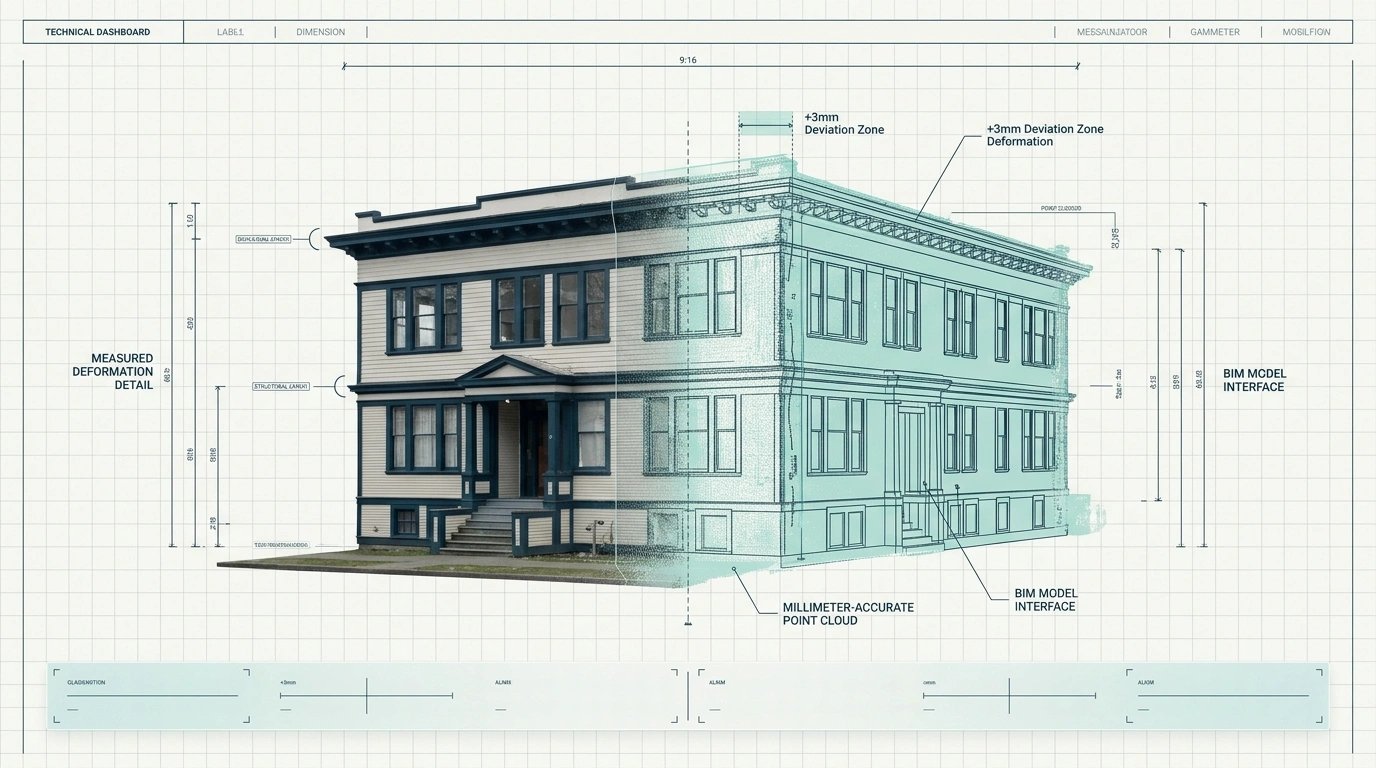
3D laser scanning eliminates these issues by capturing the building as it actually exists, producing a millimeter-accurate point cloud that becomes the foundation for all permit drawings.
Scan-to-BIM: The Modern Standard for Permit Documentation
The industry is rapidly shifting toward Scan-to-BIM workflows, where real-world conditions are converted into coordinated digital models.
This process produces:
Accurate CAD floor plans (DWG)
Coordinated elevations and sections
Structural framing layouts
BIM models for coordination and analysis
Key advantage: All drawings originate from a single verified dataset, eliminating inconsistencies between disciplines.
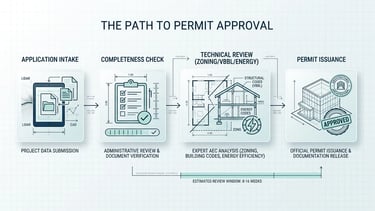
Municipal Review Process: Where Most Delays Happen
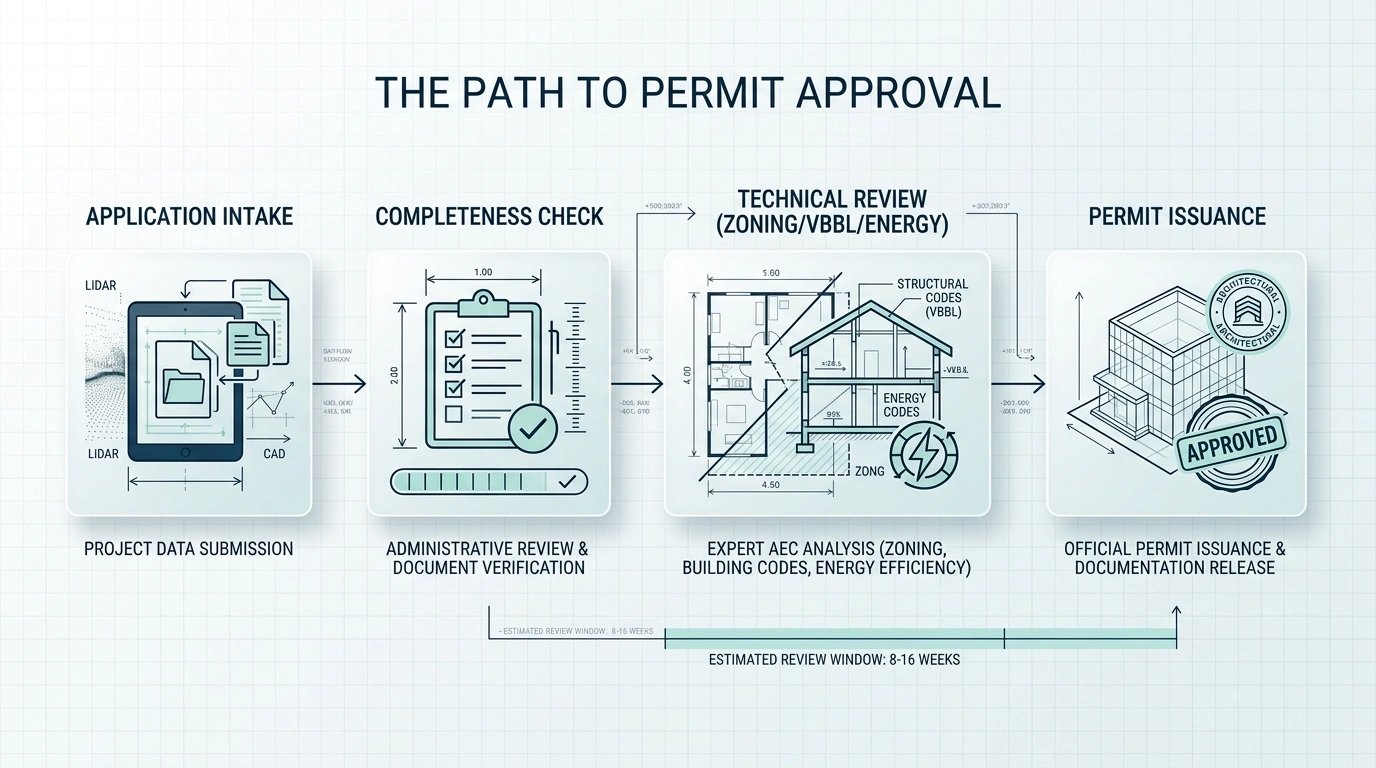
In the City of Vancouver, permit applications pass through two main stages:
1. Completeness Check
Reviewers confirm:
All required sheets are included
Drawings meet formatting standards (vector PDF required)
Zoning and basic compliance are addressed
If anything is missing → application is rejected immediately.
2. Technical Review
Engineers and planners assess:
Structural feasibility
Zoning compliance (FSR, setbacks, height)
Code adherence (BCBC + VBBL)
Energy compliance documentation
Errors at this stage result in revision cycles that can extend approval timelines by months.
Measurement Accuracy and Zoning Compliance
Zoning compliance depends entirely on precise spatial data, including:
Floor Space Ratio (FSR)
Site coverage
Setbacks
Height restrictions
Even small measurement errors can push a design out of compliance, forcing redesigns after submission.
This is one of the most overlooked causes of permit rejection in Greater Vancouver.
Risk Reduction Through Coordinated Documentation
Poor documentation leads directly to:
Permit rejections
Contractor change orders
Schedule delays
Budget overruns
High-quality coordinated drawings significantly reduce this risk by ensuring:
Architectural, structural, and MEP alignment
Accurate dimensions across all sheets
Clear constructability before submission
This allows contractors to price projects with confidence and reduces contingency buffers.
When 3D Laser Scanning Becomes Essential
Advanced measurement is especially important for:
Major renovations and additions
Laneway homes and infill projects
Heritage building upgrades
Tenant improvements in commercial spaces
Projects with unknown or outdated drawings
In these cases, precision is not optional - it is the foundation of permit approval.
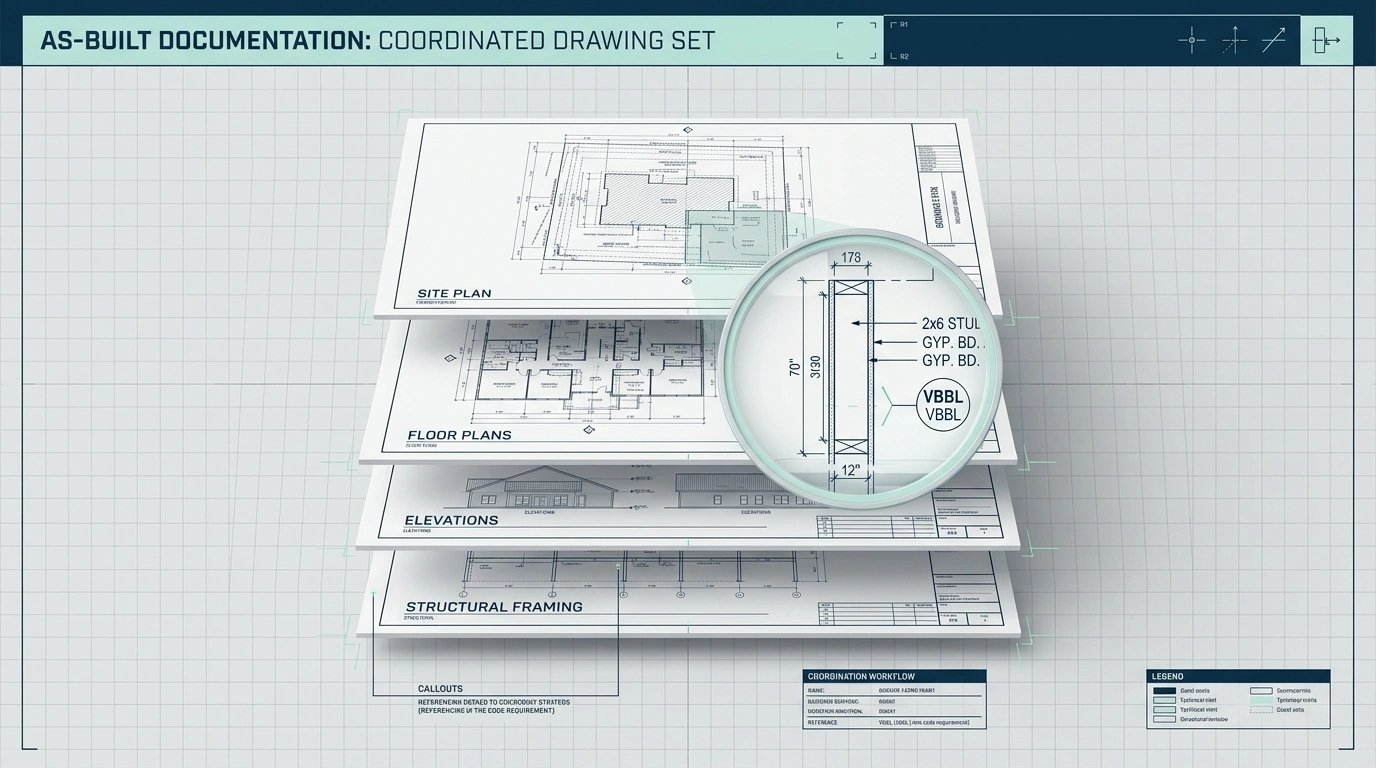
Technical Deliverables Required for Approval
A complete permit-ready drawing set typically includes:
Legal survey and site plan
Existing and proposed floor plans
Elevations and sections
Structural framing plans
MEP coordination drawings
Zoning and code compliance notes
Municipal reviewers expect all drawings to be fully coordinated and internally consistent.
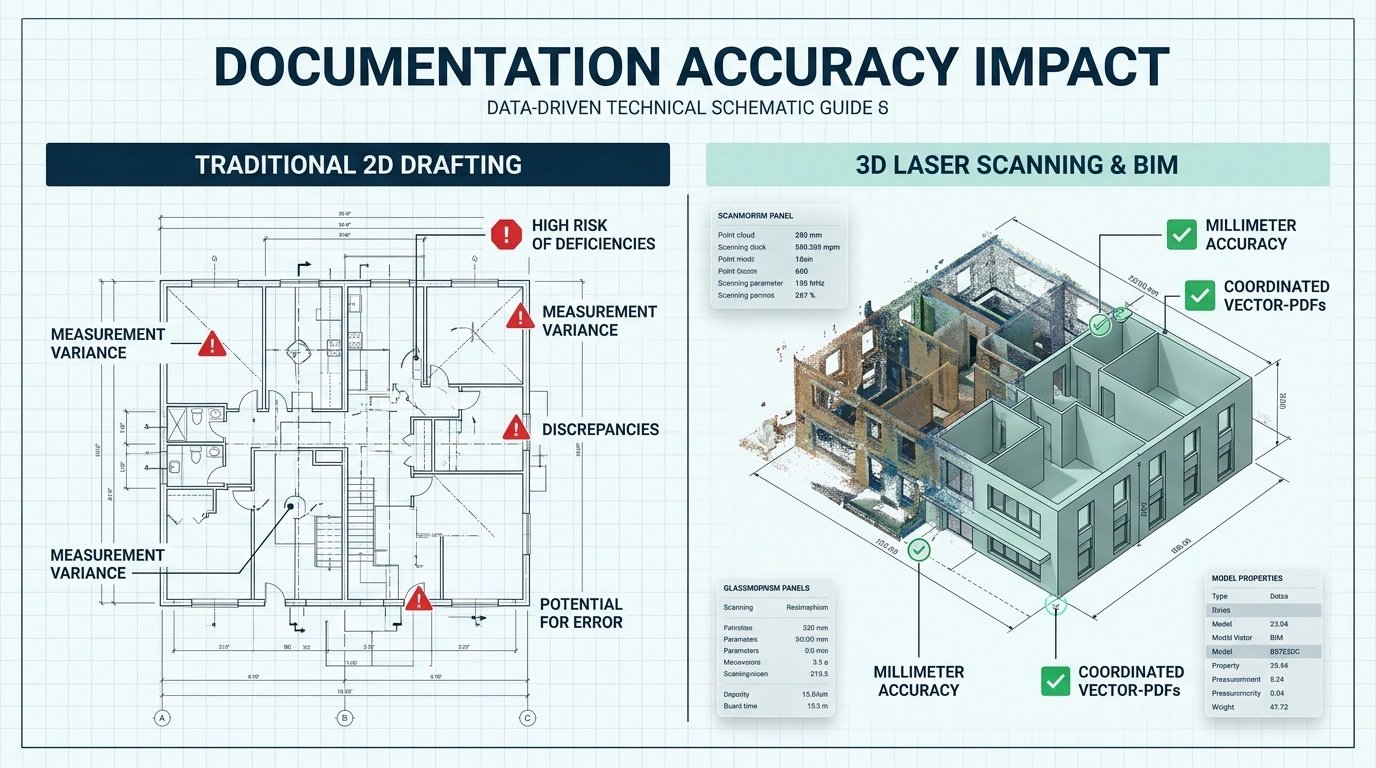
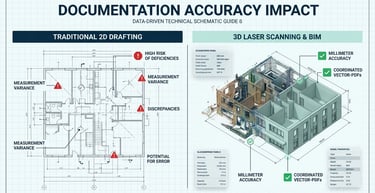
Risk & Cost Impact Summary
Factor | Traditional Drafting | Scan-to-BIM Approach
Measurement accuracy | Moderate to low | Millimeter-accurate
Permit revisions | Frequent | Minimal
Consultant coordination | Manual and inconsistent | Fully synchronized
Contractor pricing accuracy | Approximate | Highly precise
Schedule reliability | Low | High
Methodology: How Professional Permit Sets Are Built
A compliant workflow typically includes:
1. Site Capture – 3D laser scanning of existing conditions 2. Data Processing – registration of point cloud dataset 3. Model Development – conversion into CAD/BIM 4. Coordination Review – alignment across disciplines 5. Permit Package Assembly – structured vector PDF submission
Each step ensures the final package is consistent, measurable, and review-ready.
Common Myths About Vancouver Permits
Myth 1: Minor renovations don't need permits
Reality: Any work affecting structure, fire separation, plumbing, or egress typically requires approval.
Myth 2: Hand measurements are sufficient for submission
Reality: Measurement errors are one of the top causes of zoning non-compliance.
Myth 3: Once submitted, the city will fix minor issues
Reality: Incomplete or inconsistent submissions are rejected, not corrected.
Myth 4: Unpermitted work is low risk
Reality: It can result in stop-work orders, fines, and insurance complications during resale.
FAQ
How long does a Vancouver building permit take?
Typically 6–16 weeks for residential projects, longer for complex additions or multi-unit developments.
What is the most common reason for permit rejection?
Inconsistent or incomplete drawings, especially between architectural and structural sets.
Why are vector PDFs required?
They allow municipal staff to measure directly within drawings without pixel distortion.
Do I need 3D scanning for every project?
Not every project, but it is highly recommended for renovations, additions, and any building without reliable existing drawings.
Can construction start before permit approval?
No. All construction must wait until official permit issuance.
Conclusion
In Greater Vancouver's strict regulatory environment, successful permit approval depends on one factor above all others: precision in documentation.
Contractors who rely on accurate as-built data and coordinated Scan-to-BIM workflows significantly reduce risk, shorten approval timelines, and avoid costly redesign cycles.
In modern construction, permits are no longer just paperwork - they are a test of data accuracy.
Contact MeasureBuilt today to get precision as-built documentation and Scan-to-BIM services that get your Vancouver permit approved faster.
MeasureBuilt: Where Details Matter
MeasureBuilt
Address
413-8188 Manitoba Street
Vancouver, BC V5X 4L8
Contacts
236-232-3335
emil@measurebuilt.com
When Details Matter!