Tmeasurement errors Vancouver: avoid costly as-built mistakes
Tmeasurement errors Vancouver can derail permits and budgets. Learn the top as-built pitfalls and how 3D laser scanning prevents rework and delays.
3D SCANNING
Emil Jordan
2/11/20264 min read
In construction and real estate, accuracy is not a luxury - it is infrastructure. Whether managing a commercial retrofit in downtown Vancouver or planning a residential addition in Kitsilano, the integrity of your project depends on the precision of your as-built drawings.
Yet many professionals underestimate how small discrepancies compound. Measurement errors Vancouver project teams encounter routinely lead to budget overruns, permit delays, design conflicts, and unnecessary rework.
As-built drawings are not a formality. They are the verified record of how a building actually exists - capturing field changes, deviations, and hidden conditions. When documentation is inaccurate, every downstream decision is compromised.
This guide outlines the most common as-built documentation failures and explains how modern 3D laser scanning services are redefining accuracy across Greater Vancouver projects.
Why Accuracy in As-Builts Matters
Inaccurate documentation creates cascading risk:
Financial Impact
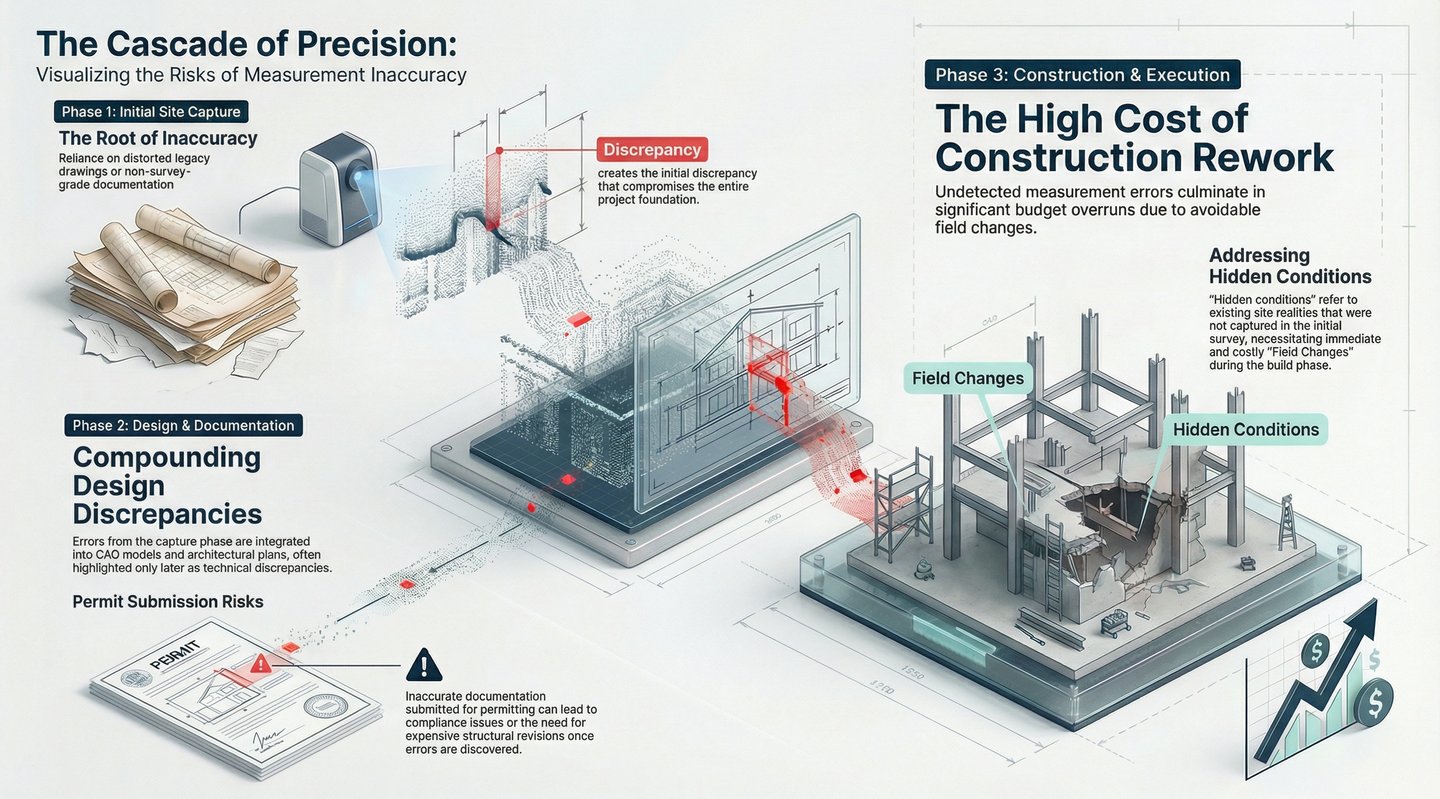
Minor dimensional errors distort material takeoffs and contractor estimates. Even small variances multiplied across a 50,000+ SF building can cost thousands.
Regulatory Delays
Municipalities across the Lower Mainland require precise building permit drawings. Inconsistent dimensions or misrepresented areas frequently trigger revisions and re-submissions.
Operational Risk
For facility managers, as-builts function as the building's operating manual. Misidentified shut-off valves, electrical panels, or structural elements create long-term inefficiencies and safety concerns.
Precision is not just technical discipline - it protects asset value.
Mistake 1: Treating Record Drawings as Reality
Original design drawings reflect intent, not outcome.
Construction evolves. Field adjustments, material substitutions, and undocumented renovations alter buildings over time. Relying on legacy drawings without verification is one of the most common sources of measurement errors Vancouver professionals encounter.
A shifted load-bearing wall or rerouted plumbing stack from a prior renovation can derail a new project if not identified early.
Best Practice:
Never treat existing drawings as the single source of truth. Conduct a full site verification before design begins. As-built surveys must reflect physical reality - not assumptions.
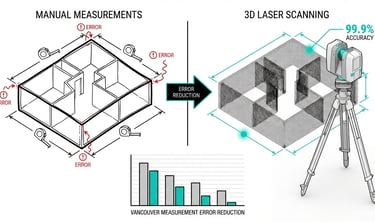
Mistake 2: Cumulative Error from Manual Measurements
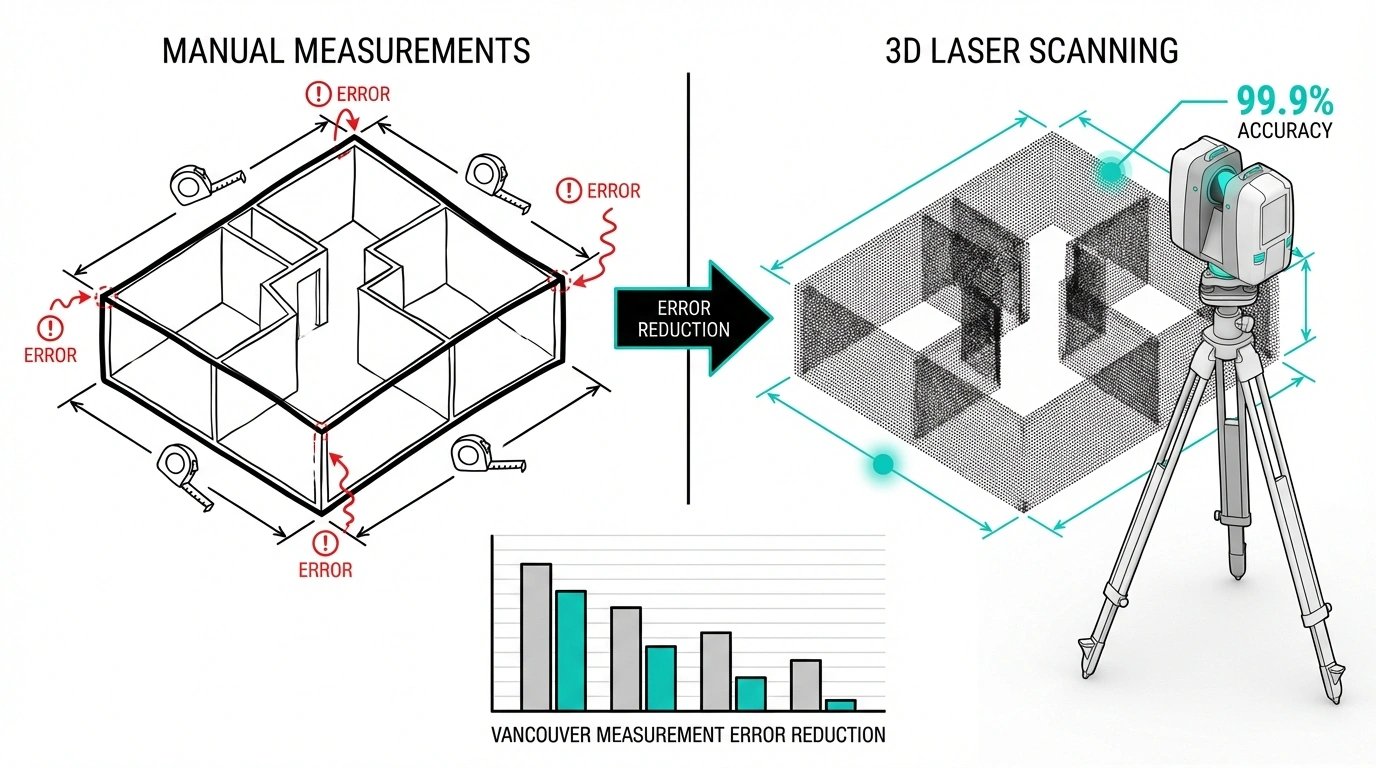
Tape measures and handheld laser distometers have limits. While adequate for isolated checks, they introduce cumulative error across larger spaces.
In multi-room or multi-floor properties, small discrepancies create closure errors - where interior dimensions no longer reconcile with exterior building envelopes.
Manual tools also fail to capture:
Out-of-plumb walls
Non-90° corners
Floor deflection
Beam sag
Irregular geometries
Older Vancouver buildings rarely conform to perfect geometry. Linear measurements oversimplify complex realities.
This is where many "accurate floor plans" quietly become inaccurate.
Mistake 3: Ignoring MEP Systems
Architectural shells alone are insufficient.
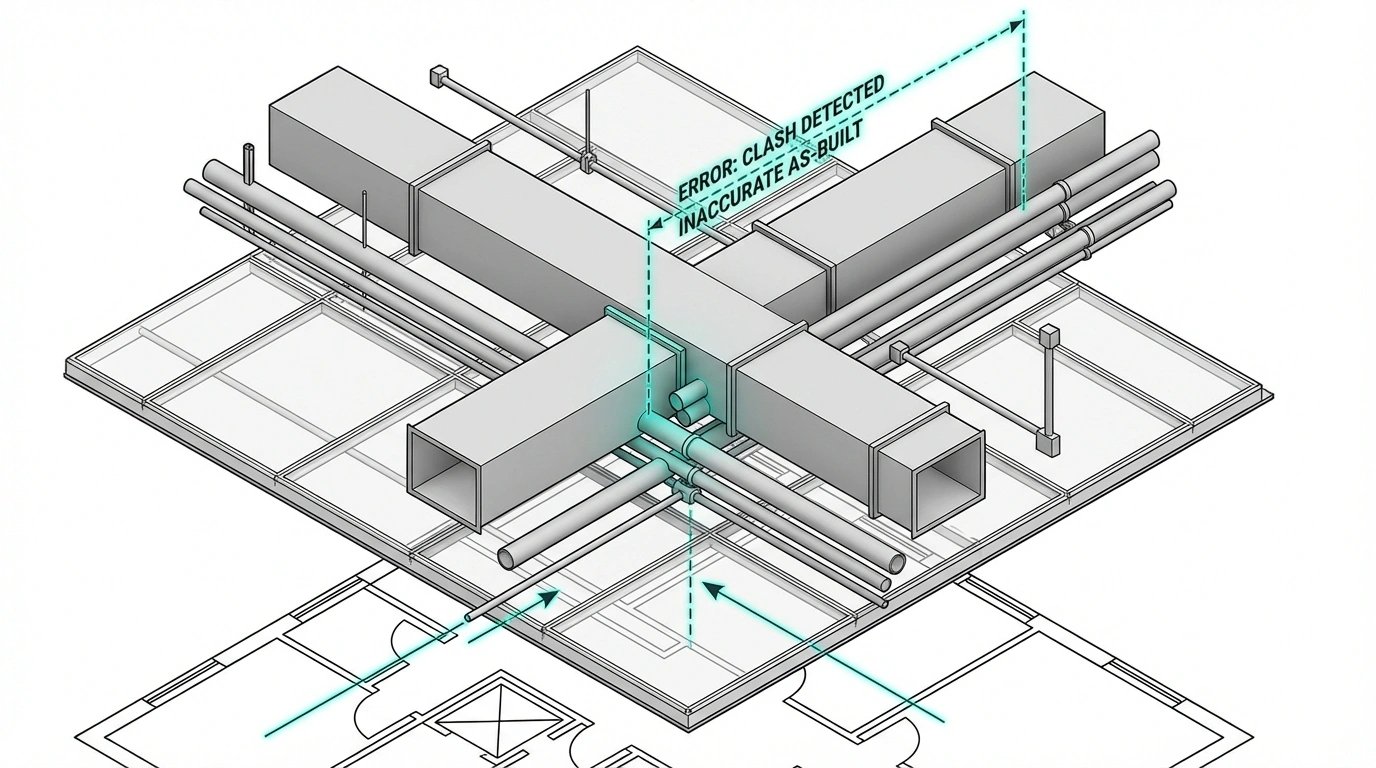
Mechanical, electrical, and plumbing (MEP) systems are frequent sources of renovation conflict. Undocumented ductwork, pipe reroutes, or electrical changes cause installation clashes and mid-project redesigns.
In high-density residential or industrial facilities, concealed systems are often the primary constraint.
Mitigation Strategies:
Capture open-ceiling conditions during demolition
Document vertical risers and drops
Integrate field markups from trades into master CAD/BIM files
As-built documentation must reflect infrastructure - not just walls.
Mistake 4: Lack of Standardization
Accuracy without clarity is still failure.
Inconsistent symbols, scales, annotation standards, or Level of Development (LOD) create communication breakdowns between architects, engineers, contractors, and designers.
Common issues include:
Mixed drawing scales
Ambiguous symbols
Missing material specifications
Inconsistent area calculation methodology
For leasing, valuation, and permit submissions, standardization is critical. Alignment with BC Building Code requirements and BOMA measurement standards ensures defensibility.
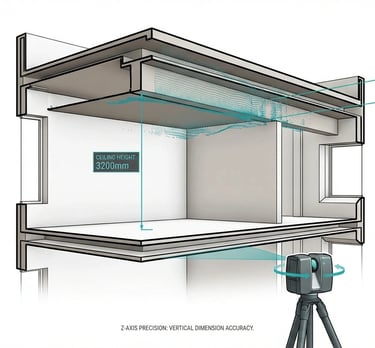
Mistake 5: Neglecting Vertical Data (The Z-Axis)
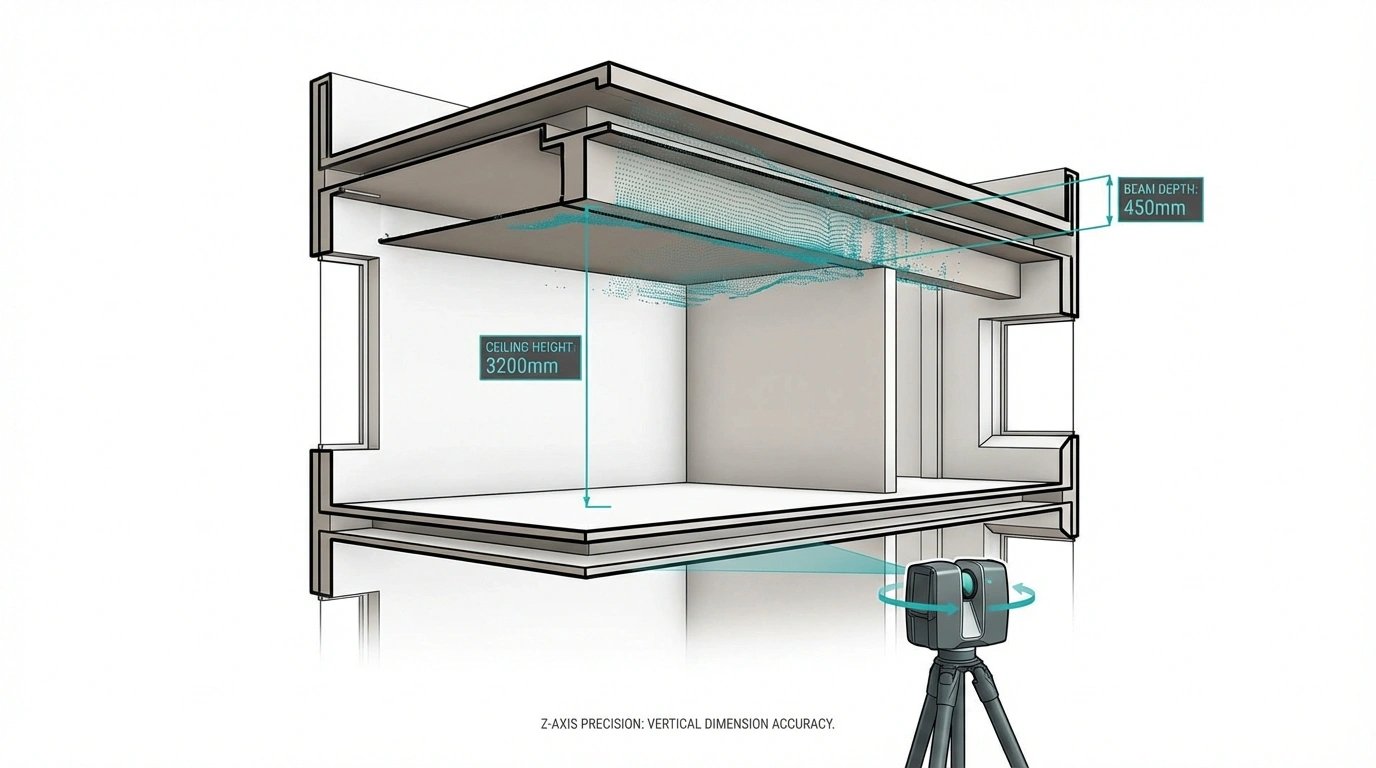
Many as-built surveys focus on plan view (X and Y axes) while under-documenting vertical information.
Ceiling heights, beam depths, slab depressions, and window head elevations directly impact:
Interior designer layouts
Millwork fabrication
Equipment installation
Code compliance
A beam documented two inches too high can invalidate cabinetry design. A misrepresented ceiling plenum can derail HVAC coordination.
Comprehensive construction documentation includes reflected ceiling plans, sections, and elevation data - not just floor plans.
The Modern Solution: 3D Laser Scanning Services
To reduce measurement errors Vancouver projects frequently experience, the industry is moving toward high-density data capture through 3D laser scanning.
Why It Works
A 3D scanner captures millions of data points per second, generating a precise point cloud - effectively a digital twin of the building.
Advantages:
Millimeter-level accuracy
Complete spatial capture (not selective measurement)
Safer documentation of difficult or elevated areas
Reduced site revisits
Visual verification through photographic overlays
Unlike manual methods, scanning captures reality - including deflections, irregularities, and concealed conditions visible at the time of scanning.
From Scan to Deliverable
Raw scan data is processed into:
Fully dimensioned floor plans
Reflected ceiling plans
Elevations and sections
3D BIM models
GBA and rentable area calculations
Real estate floor plans
This "scan-to-BIM" workflow ensures that building permit drawings submitted to the City of Vancouver are based on verifiable conditions.
For leasing and acquisition due diligence, this level of documentation significantly reduces liability exposure.
Best Practices for Reliable As-Built Results
1. Document Continuously
As-built documentation should be ongoing. Redline field changes immediately and verify before project closeout.
2. Establish a Single Source of Truth
Use a centralized BIM model or Common Data Environment (CDE) to eliminate version conflicts.
3. Verify Before Design
Commission a professional as-built survey prior to any home renovation Greater Vancouver project. The survey cost is negligible compared to corrective construction work.
4. Protect Real Estate Value
Accurate real estate floor plans directly influence valuation. In Vancouver's market, misrepresentation of square footage carries financial and legal consequences.
Conclusion
The foundation of a successful project is not concrete - it is data.
By eliminating measurement errors Vancouver teams commonly face and adopting modern capture methods, project risk decreases dramatically. Accurate as-builts support realistic contractor estimates, faster permit approvals, coordinated trades, and predictable outcomes.
High-quality construction documentation is not an expense. It is risk mitigation.
Ready to Build on Verified Data?
If you are planning a renovation, acquisition, or leasing analysis in Greater Vancouver, ensure your project begins with accurate documentation.
Contact MeasureBuilt today to discuss how our precision measurement solutions can secure your investment.
Contact us
MeasureBuilt
Address
413-8188 Manitoba Street
Vancouver, BC V5X 4L8
Contacts
236-232-3335
emil@measurebuilt.com
When Details Matter!