Measuring Services ROI Vancouver: Cut Construction Costs
Meta Description: Calculate your measuring services ROI in Vancouver. Learn how 3D laser scanning and accurate measurements generate massive construction cost savings in BC.
3D SCANNING
Emil Jordan
3/26/20265 min read
Investing in professional measuring services and 3D laser scanning is more than just a cost—it's a strategic move that delivers measurable returns for property owners, contractors, and design professionals in Vancouver. By preventing costly construction rework, eliminating system clashes, and accelerating municipal permit approvals, professional surveying transforms measurement from a line-item expense into a risk-mitigation asset.
In the Greater Vancouver market, inaccurate or outdated measurements can lead to change orders averaging 5% to 15% of total project value, proving that professional documentation often pays for itself before construction even begins.
Why Professional Measuring Services Matter in Vancouver
Relying on manual tape measurements or legacy 2D blueprints exposes projects to financial, operational, and regulatory risk. Modern measuring services deploy advanced technologies, including LiDAR scanning and Scan-to-BIM workflows, to produce millimeter-accurate digital twins of existing conditions.
Key Benefits:
Eliminates unforeseen site conflicts
Streamlines permitting processes with accurate BC Building Code compliance
Ensures precise MEP (Mechanical, Electrical, Plumbing) integration
Reduces costly change orders and material waste
By investing in professional scanning upfront, project managers protect budgets, timelines, and design integrity.
Core Analysis: Industry Logic and Financial Impacts
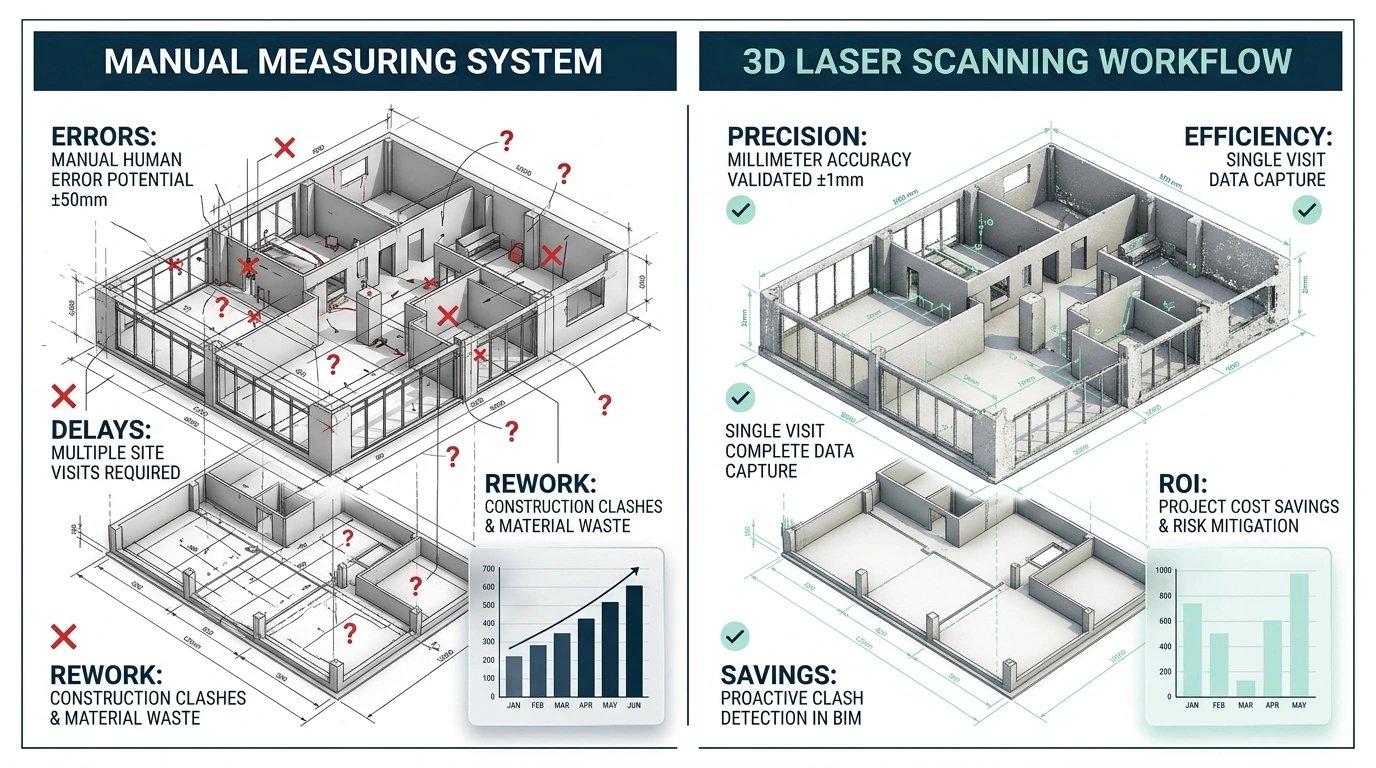
In the Architecture, Engineering, and Construction (AEC) sector, ROI from professional measurement is undeniable. The logic is simple: accurate data eliminates guesswork. When rework typically consumes 5–12% of a project's budget, professional scanning is essentially an insurance policy that pays for itself.
BC Building Code Implications
The BC Building Code requires strict adherence to spatial and structural tolerances. Whether performing a seismic upgrade or a multi-family retrofit, millimeter-accurate scans ensure architectural plans reflect reality, preventing:
Permit rejections
Structural violations
Delays due to undocumented conditions
Professional 3D scanning captures existing conditions with 1–3mm precision, giving Vancouver projects an edge in municipal approvals.
Renovation Workflows in Greater Vancouver
Vancouver's mix of aging infrastructure and modern developments makes renovations complex. Professional measuring services provide a single, hyper-accurate baseline, eliminating common communication breakdowns and reducing risk of rework.
Measurement Accuracy and Quality Assurance
Manual measurement: ±13mm, highly susceptible to human error
3D laser scanning: ±1–3mm, providing sub-millimeter accuracy
Point cloud data allows designers to overlay scans on project models, performing instant deviation analysis for QA.
Scan-to-BIM and Documentation Standards
Scan-to-BIM transforms point clouds into intelligent 3D BIM models, enabling:
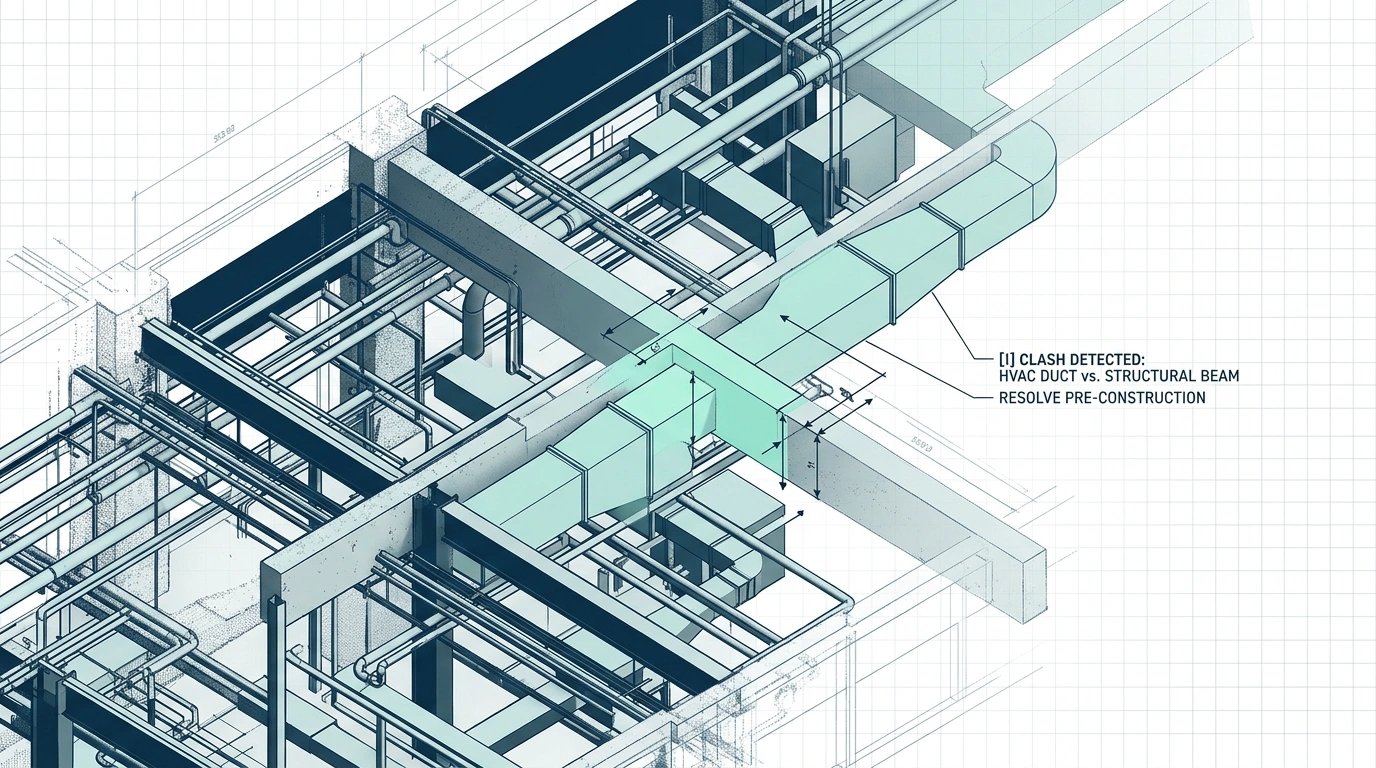
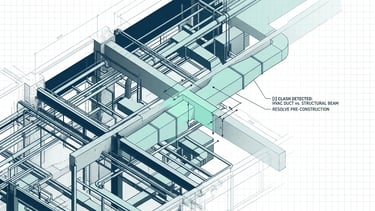
Digital clash detection
Efficient coordination between MEP, architectural, and structural teams
Reduced field rework, saving thousands of dollars
This workflow is now the gold standard for Vancouver projects, particularly for high-density condos, heritage restorations, and complex commercial retrofits.
Risk Mitigation and Cost Control
Early detection of hidden structural or MEP conflicts can save substantial costs. Example: discovering a hidden post-tensioned beam during HVAC installation could trigger a $50,000+ change order. A pre-construction laser scan identifies conflicts digitally, often yielding ROI exceeding 1,400%.
Extended Scenarios: Practical ROI Analysis
Scenario 1: Complex MEP Coordination in Commercial Retrofits
Technical context: 3D laser scanners capture existing pipes and ductwork above drop ceilings
Workflow impact: Engineers plan new routes using point cloud data and digital clash detection
Financial implications: Resolving conflicts digitally is 10x cheaper than field fixes
Regulatory considerations: Ensures BC Fire Code and municipal clearance compliance
Scenario 2: Heritage Building Restorations
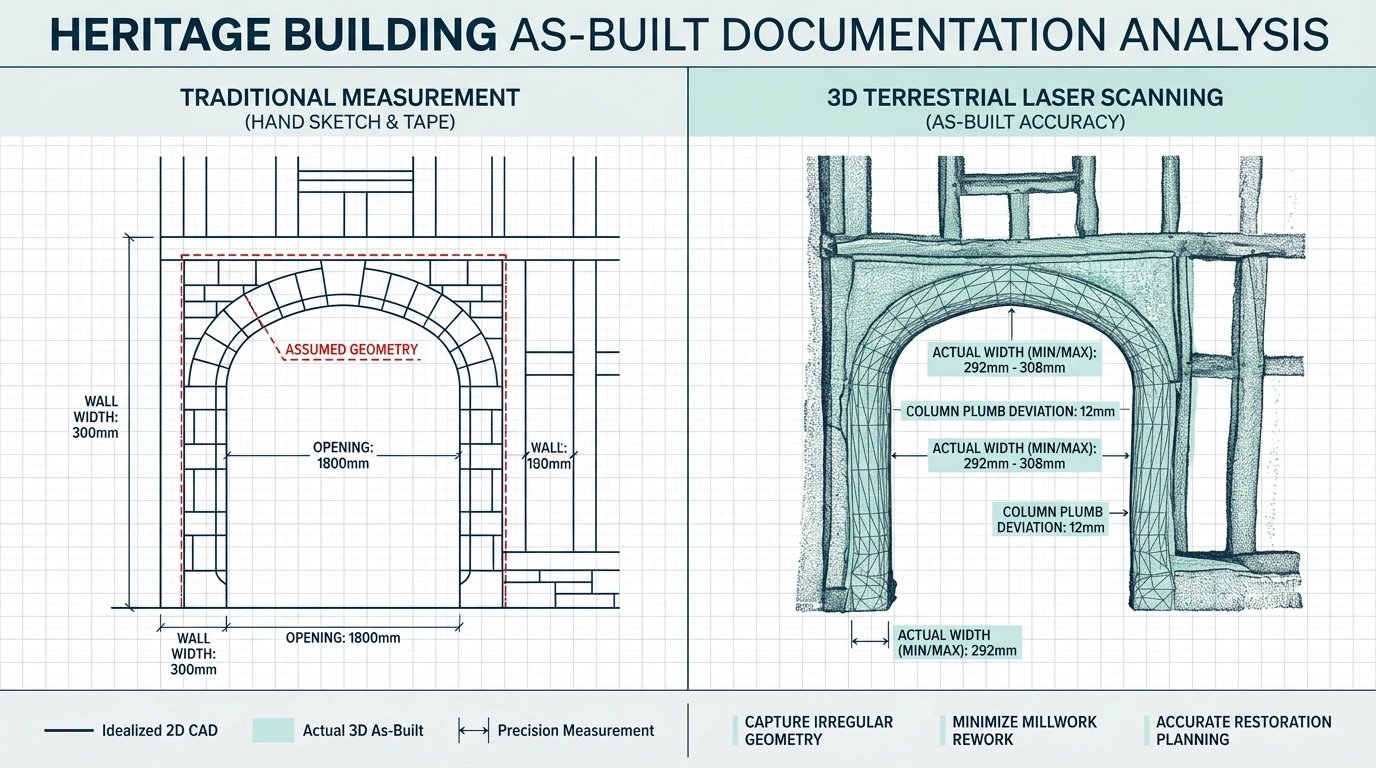
Technical context: Older Vancouver buildings feature irregular geometries and sagging floors
Workflow impact: Terrestrial laser scanning captures intricate details without physical contact
Financial implications: Prevents costly errors when fabricating custom historical millwork
Regulatory considerations: Provides detailed documentation for heritage committee approvals
Scenario 3: Municipal Permitting and Residential Additions
Technical context: Accurate property boundaries and roof pitches captured via 3D scans
Workflow impact: Scan data converted into 2D as-built floor plans for permit applications
Financial implications: Fast-tracking permits avoids months of holding costs (taxes, interest)
Regulatory considerations: Ensures compliance with Vancouver's Floor Space Ratio (FSR) and setbacks
ROI Comparison: Manual Measurement vs Professional 3D Scanning
Accuracy
Traditional manual measurement: ±13–25mm; human error prone
Professional 3D laser scanning: ±1–3mm; mathematically precise
ROI / Financial impact: Eliminates re-fabrication costs
Time on Site
Traditional manual measurement: Days or weeks; frequent returns
Professional 3D laser scanning: Hours to days; no return visits
ROI / Financial impact: Reduces labor costs and downtime
Clash Detection
Traditional manual measurement: Reactive; discovered on-site
Professional 3D laser scanning: Proactive; resolved digitally
ROI / Financial impact: Saves $10,000–$100,000+
Data Utility
Traditional manual measurement: Flat 2D sketches
Professional 3D laser scanning: 3D environments, BIM-ready
ROI / Financial impact: Maximizes downstream efficiency
Risk Profile
Traditional manual measurement: High
Professional 3D laser scanning: Low; total spatial transparency
ROI / Financial impact: Protects contingency and profit margins
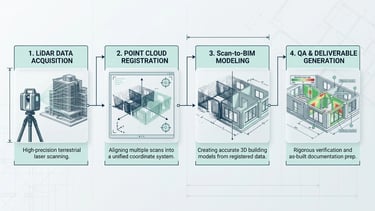
Methodology: Workflow Logic
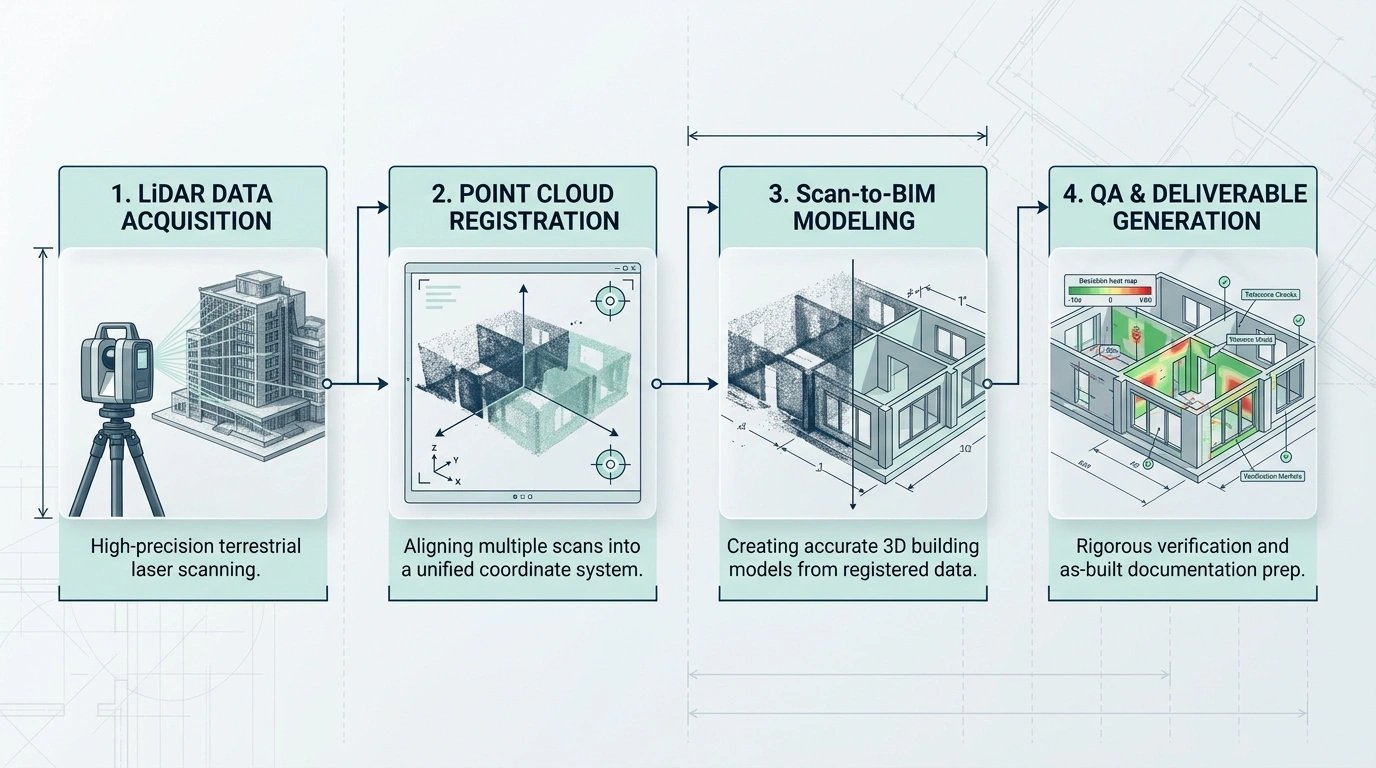
Technical context: LiDAR scanners sweep every surface, capturing millions of points
Workflow impact: Individual scans stitched to create a unified 3D model
Financial implications: Reduces site-visit costs and billable hours
Regulatory considerations: Scan-to-BIM / CAD drafting — point clouds converted into 2D floor plans and intelligent 3D models; models cross-referenced against raw scans for millimeter-level accuracy
Myth-Busting: Professional Measuring Services
Myth 1: Scanning is too expensive for standard renovations
Fact: Cost is a fraction of the potential $50,000+ error from manual measurement
Myth 2: Contractor hand measurements are sufficient
Fact: Walls are rarely straight; hand measurements miss subtle structural deviations
Myth 3: Matterport tours are equivalent to 3D laser scanning
Fact: Matterport lacks survey-grade accuracy needed for engineering
Myth 4: Scanning slows pre-construction
Fact: Scanning accelerates workflows and eliminates repeated site visits
FAQ: Professional Measuring and Scanning Services in Vancouver
1. How much do measuring services cost in Vancouver?
Small residential 2D as-builts: $1,000–$3,500
Medium commercial Scan-to-BIM: $8,000–$30,000
2. What is the typical ROI?
Reduces rework costs by 5–15% of total project value
ROI often 1,000–1,500% of scanning cost
3. Why are laser scanners better than manual measurements?
Captures millions of points per second with millimeter accuracy
Eliminates blind spots in floors, ceilings, and hidden MEP systems
4. How does Scan-to-BIM reduce change orders?
Digital clash detection identifies conflicts before construction.
5. Are 3D scans required for Vancouver permits?
Not mandatory, but ensures precise, approval-ready as-built documentation.
6. What deliverables should I expect?
Raw point clouds (.RCP / .E57)
Accurate 2D CAD drawings (.DWG / PDF)
Intelligent 3D BIM models (.RVT)
7. How long does scanning take?
Single-family homes / small commercial: few hours
Large commercial: several days
Drafting & processing: 1–3 weeks
8. Can 3D scanning capture outdoor exteriors and site topography?
Yes. LiDAR scanners and drones map rooftops, terrain, and site conditions accurately.
Conclusion
For Vancouver property owners, contractors, and interior designers, professional measuring services are more than a tool—they're an investment. By leveraging 3D laser scanning and Scan-to-BIM workflows, projects benefit from:
Reduced risk and financial exposure
Accurate municipal permit submissions
Lower construction costs
Streamlined project delivery
When analyzed through a ROI lens, investing in professional measurement pays for itself many times over, making it a critical component of modern AEC projects in Greater Vancouver.
Contact Us
MeasureBuilt
Address
413-8188 Manitoba Street
Vancouver, BC V5X 4L8
Contacts
236-232-3335
emil@measurebuilt.com
When Details Matter!