Interior Design Vancouver: The As-Built Floor Plan Guide
Elevate your interior design Vancouver projects with accurate as-built floor plans. Discover how 3D laser scanning optimizes space planning services in BC.
INTERIOR DESIGN3D SCANNING
Emil Jordan
3/12/20264 min read
Accurate as-built drawings are a designer's secret weapon for achieving flawless interior renovations and space planning in Vancouver. By leveraging professional 3D laser scanning services, interior designers can eliminate costly measurement errors, avoid rework, and ensure precise installation of custom cabinetry, millwork, and complex MEP (Mechanical, Electrical, and Plumbing) systems.
In the high-stakes Greater Vancouver real estate market, verified as-built documentation bridges creative vision with structural reality, while ensuring strict compliance with the BC Building Code and municipal permit requirements.
This guide explains how professional as-built floor plans enhance project outcomes, reduce financial risks, and empower designers to work with confidence.
Why As-Built Floor Plans Are Critical for Interior Designers
A digital-first approach captures every millimeter of a building's existing conditions, reducing the risks associated with:
Design clashes between new and existing elements
Unexpected site conditions or irregularities
Change orders that drive up costs
Permit delays due to inaccurate documentation
Verified as-built drawings provide a single source of truth for architects, engineers, and contractors, ensuring that the design intent aligns with both physical reality and regulatory requirements.
The Architecture of Precision: Key Drivers for Vancouver Projects
Professional measurement transforms interior design by combining technology, regulatory knowledge, and quality assurance. Key pillars include:
1. BC Building Code Compliance
The City of Vancouver enforces strict building regulations. Accurate as-built documentation ensures that design proposals:
Meet fire safety and egress requirements
Respect unprotected opening and separation standards
Facilitate smooth municipal approvals for renovations
Without verified measurements, projects risk permit delays, rework, or code violations.
2. Streamlined Renovation Workflows
Traditional workflows often rely on outdated drawings or assumptions, leading to emergency redesigns during demolition. Modern measurement establishes a single source of truth from the outset, avoiding costly surprises.
3. Measurement Accuracy and Quality Assurance
Professional 3D laser scanning systems capture millimeter-level precision (typically 1–5 mm). Combined with rigorous QA processes, this ensures all dimensions are ready for immediate design use, eliminating human error from tape-measure methods.
4. Scan-to-BIM and Documentation Standards
The industry is increasingly moving from 2D drawings to Building Information Modeling (BIM). Scan-to-BIM converts point clouds into intelligent 3D models containing material metadata, spatial relationships, and structural details, representing the gold standard in Vancouver design documentation.
5. Risk Mitigation and Cost Control
Early identification of design conflicts can save hundreds of thousands of dollars. Accurate as-built drawings can reduce project rework costs by 30% or more, improving both timeline and budget efficiency.
When Professional As-Built Services Are Necessary
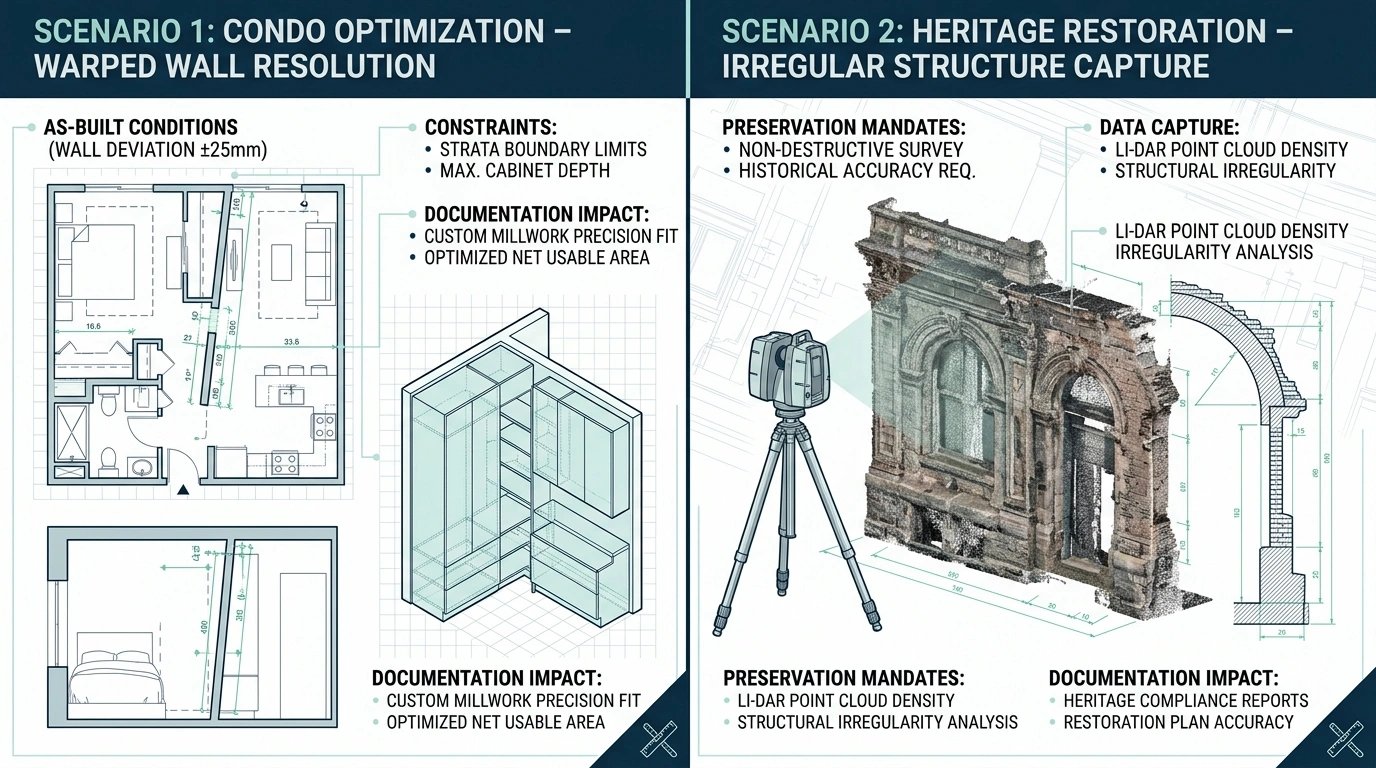
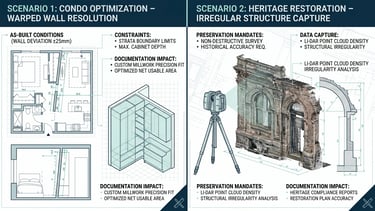
Buildings change over time, and relying on legacy blueprints is risky. Professional as-built measurements are critical in scenarios such as:
High-Density Condo Optimizations & Custom Millwork
Technical challenge: Tight floor plans, warped walls, offset structural columns
Workflow benefit: Accurate floor plans and interior elevations allow precise casework design
Financial impact: Prevents on-site adjustments and wasted materials
Regulatory consideration: Aligns with strata and municipal plumbing codes
Heritage Building Restorations
Technical challenge: Irregular geometries, sagging floors, ornate architectural details
Workflow benefit: Non-invasive 3D scanning preserves historical elements
Financial impact: Detects hidden structural issues before construction
Regulatory consideration: Supports heritage committee approvals with verified documentation
MEP Coordination and Reflected Ceiling Plans (RCPs)
Complex lighting, HVAC, and smart-home systems require precise mapping
Scan-to-BIM ensures contractors can bid accurately and eliminates unnecessary risk padding
Technical Breakdown: Accuracy, Deliverables, and Cost Impacts
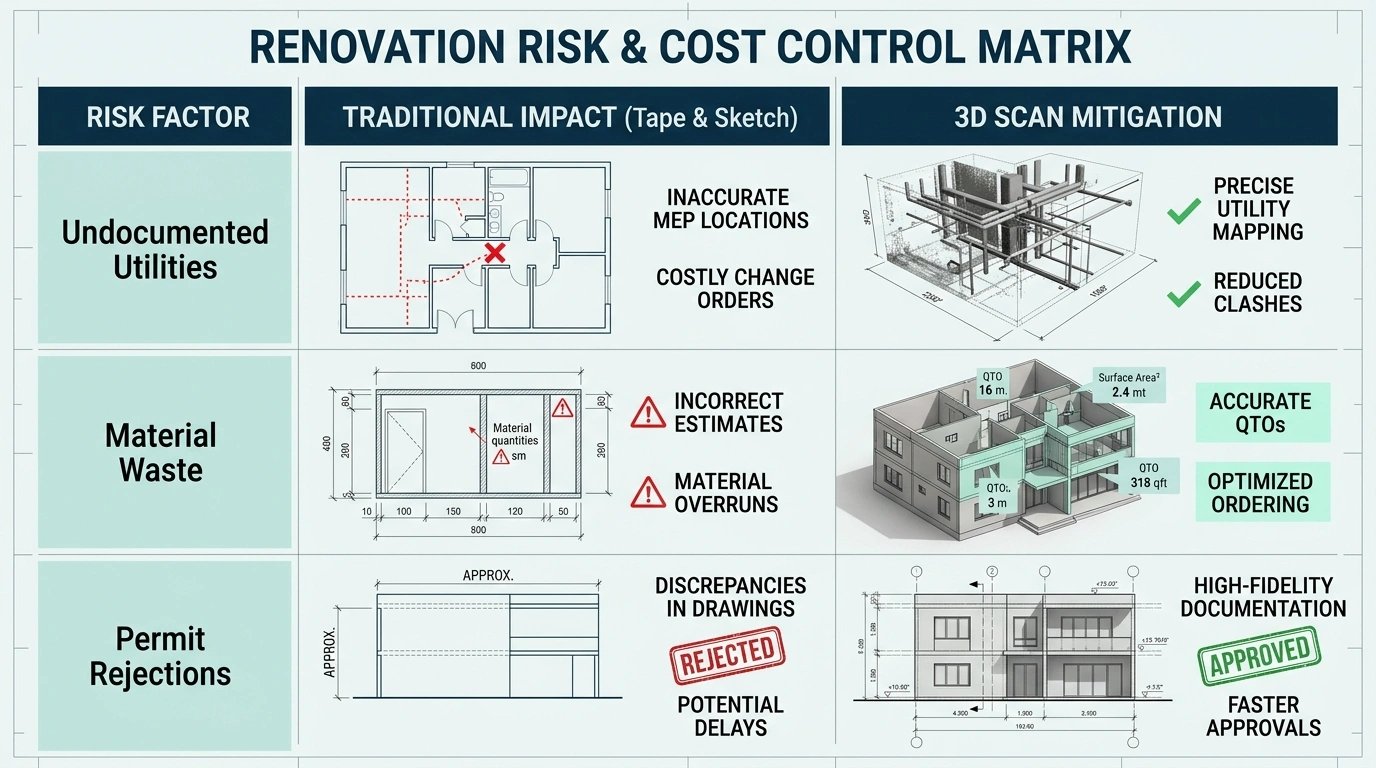
Transitioning from manual measurement to LiDAR-based scanning improves both efficiency and project economics:
Risk Factor: Undocumented Utilities
Traditional Impact: Pipes/ducts hit during demolition
3D Scan Mitigation: Point clouds capture all MEP systems
Financial Implications & Savings: Avoids emergency redesigns; saves 15–20% of delay costs
Risk Factor: Material Waste
Traditional Impact: Prefabricated millwork fails to fit
3D Scan Mitigation: Exact geometry captured
Financial Implications & Savings: Eliminates field fitting and wasted premium materials
Risk Factor: Change Orders
Traditional Impact: Design clashes cause costly variations
3D Scan Mitigation: BIM clash detection resolves conflicts digitally
Financial Implications & Savings: Prevents $150,000+ in rework
Risk Factor: Permit Rejections
Traditional Impact: Drawings fail BC Building Code spatial checks
3D Scan Mitigation: Verified measurements ensure smooth approvals
Financial Implications & Savings: Eliminates holding costs from delays
Risk Factor: Site Revisits
Traditional Impact: Missing data requires repeated trips
3D Scan Mitigation: Virtual 360° walkthroughs allow remote verification
Financial Implications & Savings: Saves dozens of billable hours
Scan-to-BIM Workflow: Step-by-Step
Professional as-built measurement follows a structured workflow:
Planning: Define Level of Development (LOD) and project scope
Capture: Terrestrial laser scanners measure millions of points per second
Processing: Align and clean point cloud data
Modeling: Convert point clouds into parametric 3D BIM models
Delivery: Export multi-format deliverables (Revit, AutoCAD, PDF) with QA checks
Myth-Busting: Traditional Methods vs Professional Reality Capture
Myth 1: Hand measurements are sufficient for interior design
Fact: Un-square corners and floor slopes lead to cumulative errors
Myth 2: Contractor red-lines are equivalent to as-built drawings
Fact: Red-lines are informal notes; as-builts are verified, legally defensible documents
Myth 3: 3D laser scanning is too expensive for residential projects
Fact: Scanning costs are a fraction of a single major construction error
Myth 4: Original blueprints reflect the actual building
Fact: Blueprints represent intent; as-builts capture reality
Frequently Asked Questions (FAQ)
What are as-built floor plans?
Detailed drawings representing the building's true, existing conditions, including modifications and deviations.
How does 3D laser scanning improve Vancouver interior design projects?
It captures millions of points in minutes, producing a millimeter-accurate digital replica for precise planning.
What's the difference between contractor markups and professional record drawings?
Markups are informal notes; professional as-builts are verified CAD/BIM models.
How do accurate as-builts affect contractor estimates and change orders?
They reduce "unknowns," allowing precise material takeoffs and eliminating costly change orders.
What deliverables should I expect from a scanning service?
2D floor plans, RCPs, elevations, cross-sections, Revit 3D BIM models, and optionally raw point cloud data.
Do I need as-builts for cosmetic renovations?
Yes. Even cosmetic work depends on accurate measurements to avoid material waste and installation errors.
How do as-builts help with BC Building Code compliance?
They verify that designs adhere to zoning, fire safety, and egress regulations, preventing permit delays.
What is the ROI for 3D laser scanning?
Scanning costs $1–10/sq ft, but ROI is often 10:1+ when factoring material savings and schedule efficiencies.
How does Scan-to-BIM support post-renovation facility management?
The digital twin serves as an interactive database for ongoing maintenance, with precise metadata on materials, utilities, and systems.
Conclusion
For interior designers in Vancouver, professional as-built floor plans are more than documentation - they are a strategic tool that ensures projects are executed flawlessly, on time, and within budget.
By adopting 3D laser scanning and Scan-to-BIM workflows, designers can transform challenging urban spaces, preserve heritage structures, and confidently navigate the BC Building Code.
Invest in accuracy today, save tens of thousands tomorrow.
Contact us
MeasureBuilt
Address
413-8188 Manitoba Street
Vancouver, BC V5X 4L8
Contacts
236-232-3335
emil@measurebuilt.com
When Details Matter!