Home Renovation Vancouver: Avoid Disasters with As-Built Surveys
Planning a home renovation Vancouver? Discover how 3D laser scanning and as-built surveys prevent $50k budget overruns and severe municipal permit delays.
3D SCANNING
Emil Jordan
3/17/20264 min read
Bypassing accurate as-built drawings is one of the leading causes of catastrophic budget overruns in residential and commercial renovations in Vancouver. Without millimeter-accurate 3D laser scanning services, property owners risk costly mid-project change orders, municipal permit delays, and structural clashes.
Investing in professional as-built surveys provides precise spatial data, aligns contractor estimates, and routinely saves tens of thousands of dollars on home renovations in Vancouver.
For homeowners, developers, and design professionals navigating the Greater Vancouver Area, proceeding without verified existing-conditions documentation is a serious financial risk. Modern 3D laser scanning and Scan-to-BIM workflows have shifted from luxury tools to baseline operational necessities for any renovation project.
The Architectural and Financial Imperative of Accurate Documentation
Renovating a Vancouver home without precise documentation is a guaranteed recipe for disaster. Unreliable measurements often lead to the "horror stories" we hear across the Lower Mainland:
Tear-down orders from municipalities
Contractor disputes
Budgets inflating by $50,000+ before drywall is installed
BC Building Code and Vancouver By-law Compliance
The British Columbia Building Code (BCBC) and Vancouver Building By-law (VBBL) impose strict structural and seismic requirements on renovations. Inaccurate floor plans can:
Cause immediate permit rejection
Prevent engineers from designing compliant upgrades
Lead to cascading project failures
Professional as-built drawings ensure that all load-bearing assemblies and structural elements are accurately documented, forming a reliable baseline for design and permitting.
Renovation Workflows in Greater Vancouver
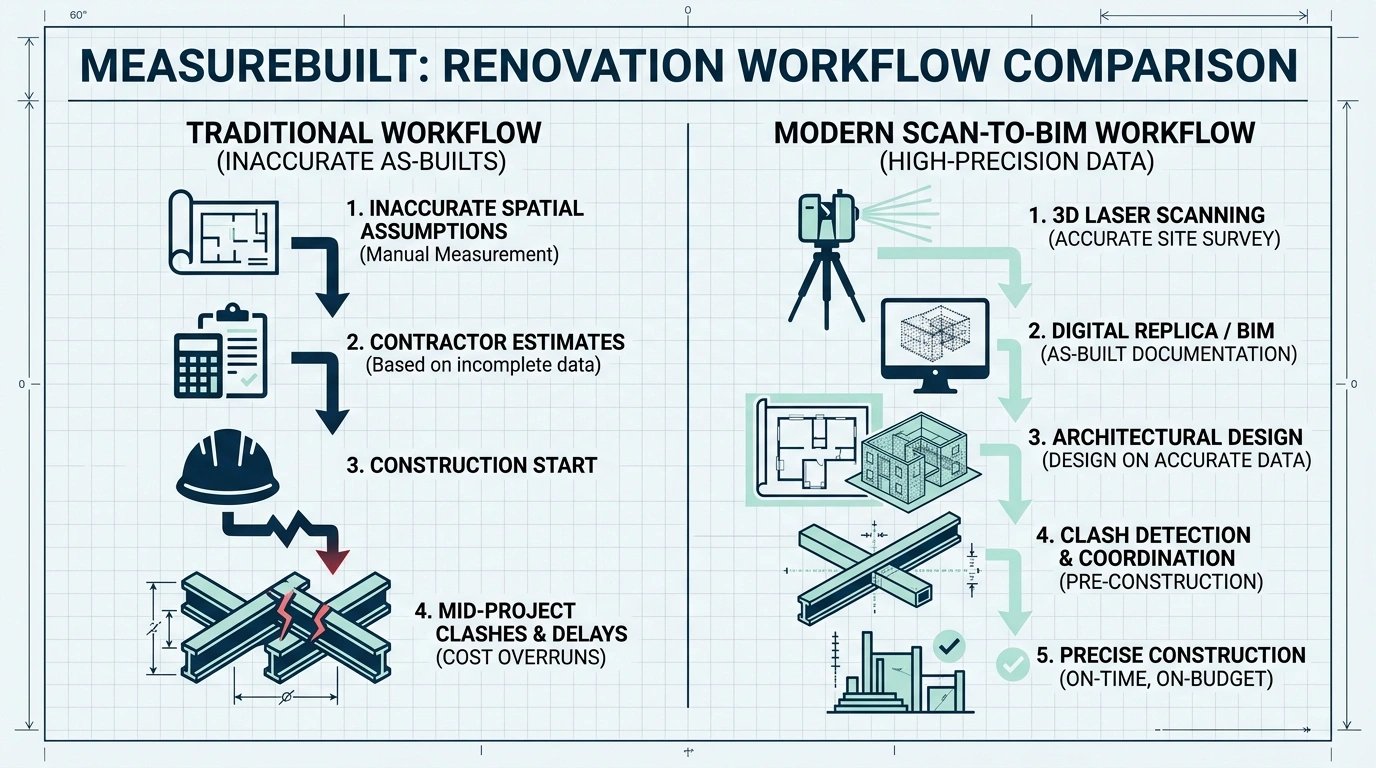
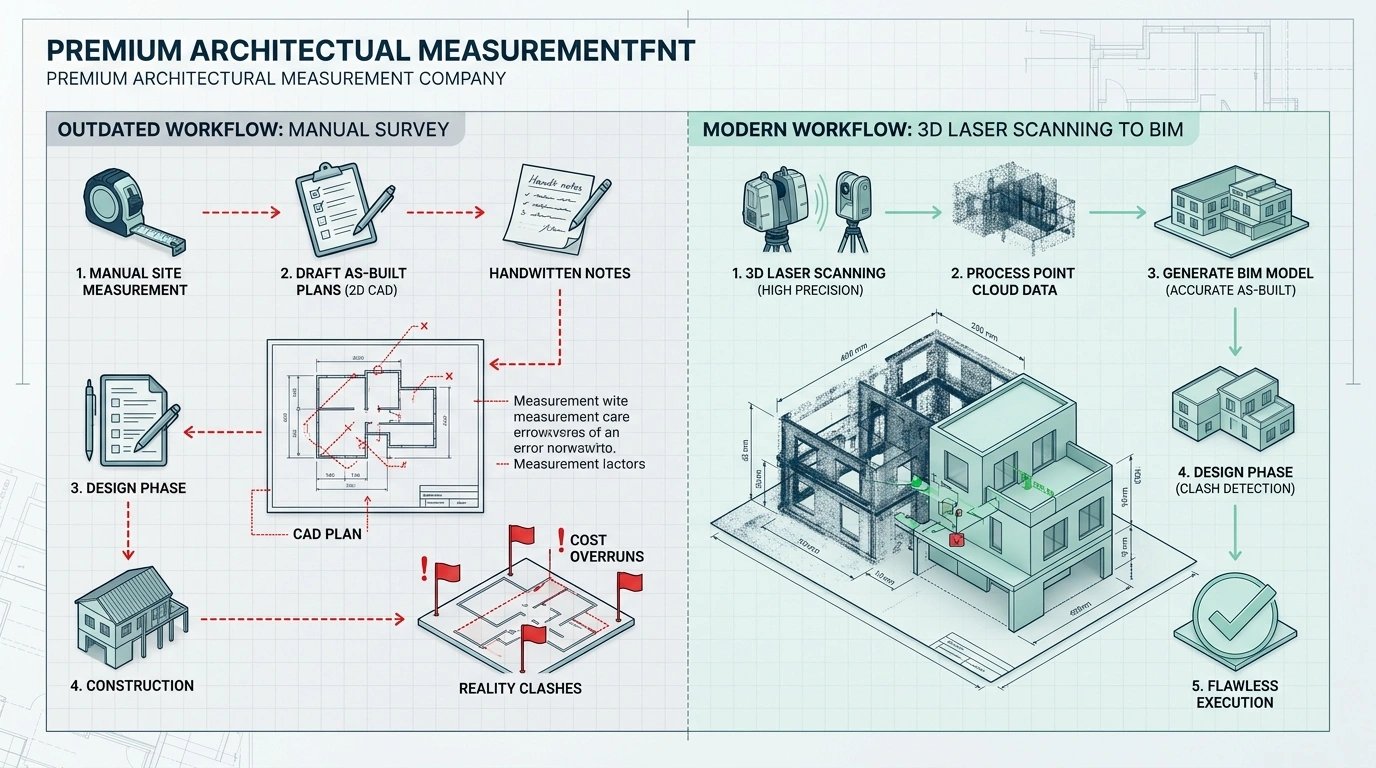
Traditional workflows - drafting 100% of permit drawings before confirming construction costs - often fail. 9 out of 10 permit-ready renovation designs contain errors caused by inaccurate measurements.
Integrating 3D laser scanning services early provides architects and designers with an exact digital replica of the property, mitigating costly surprises during construction.
Measurement Accuracy and Quality Assurance
Traditional tape measures: ±13mm accuracy; prone to error
Professional 3D scanning: ±1–3mm accuracy; survey-grade precision
Laser scans generate millions of data points per second, which are validated through rigorous QA protocols to ensure precise measurements.
Scan-to-BIM and Documentation Standards
Scan-to-BIM workflows convert raw point clouds into intelligent 3D models. Benefits include:
Accurate walls, windows, beams, and MEP systems
Virtual clash detection to resolve conflicts before construction
Reduced material waste and on-site rework
This methodology ensures that contractors and sub-trades work from a single source of truth, drastically reducing risk and preserving budgets.
Risk Mitigation and Cost Control
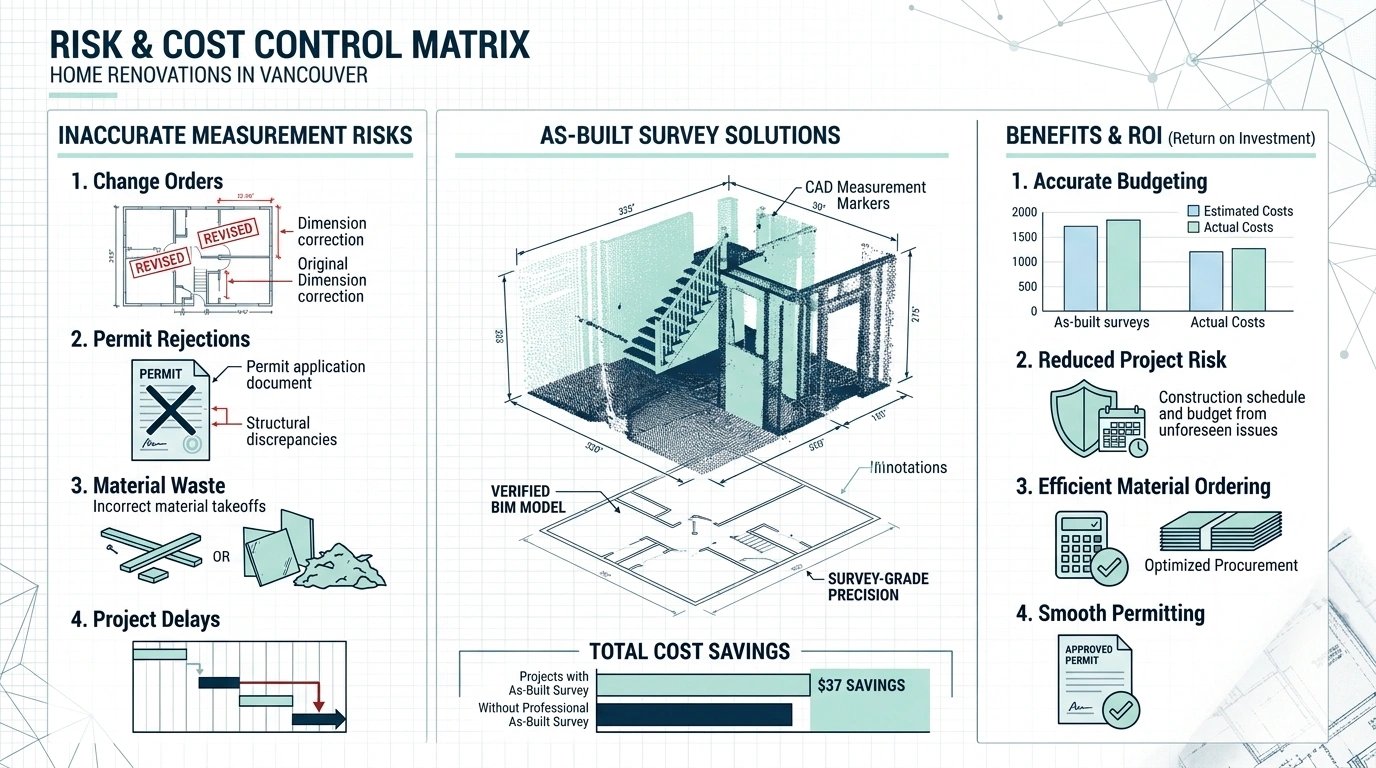
When contractors quote from inaccurate drawings, estimates either include risk premiums or omit critical work, creating 10–20% change orders during construction. Professional as-built documentation eliminates these issues, providing:
Precise construction documentation
Reliable contractor estimates
Lower risk of mid-project delays
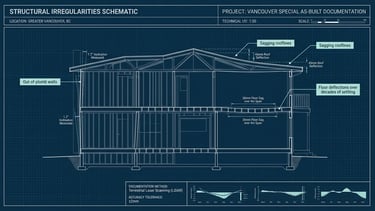
Renovating Vancouver Specials and Heritage Homes
Vancouver's older housing stock - like the Vancouver Special or heritage homes - presents unique challenges:
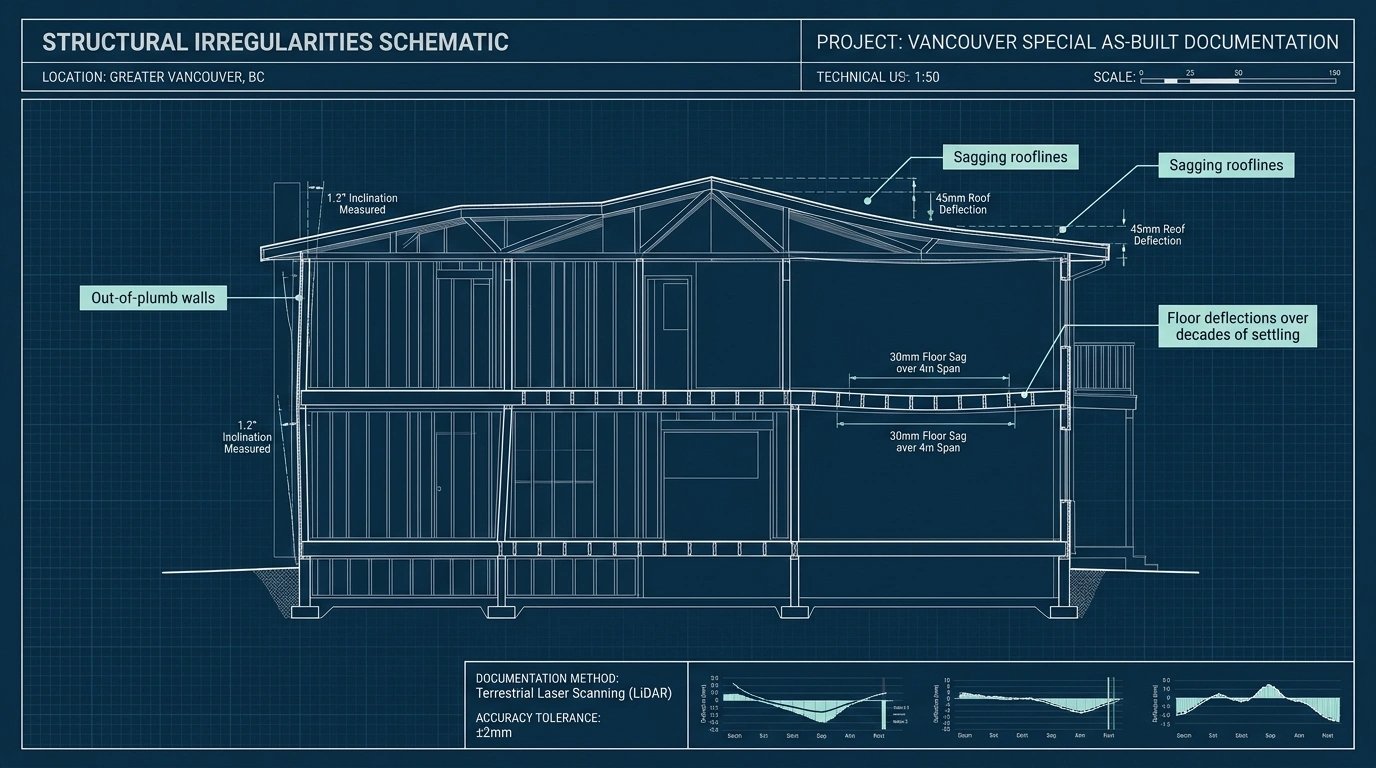
Technical context: Walls are rarely square, floors sag, and structural irregularities are common
Workflow impact: Without 3D laser scans, new layouts may be physically impossible to construct
Financial implications: Framing-stage corrections can cost $30,000–$50,000
Regulatory considerations: VBBL requires strict energy and seismic compliance
Best practice: Commission a comprehensive 3D laser scan and a detailed Revit BIM model before schematic design begins.
Design-to-Construction Handoff
The handoff from design to construction is the most volatile phase of a renovation. Accurate as-built documentation ensures:
Verified floor plans, reflected ceiling plans (RCP), elevations, and sections
Reliable contractor bids without placeholders
Compliance with permit-approved drawings
Best practice: Require all construction documentation to be based on professionally executed as-built surveys.
Permitting and Unpermitted Construction Realities
Greater Vancouver has some of the most rigorous municipal permitting processes in North America. Submitting inaccurate plans or bypassing permits can trigger:
Stop Work Orders
Mandatory demolition of newly built structures
Legal and financial liability
Best practice: Always base your permit submission on a professional 3D as-built survey.
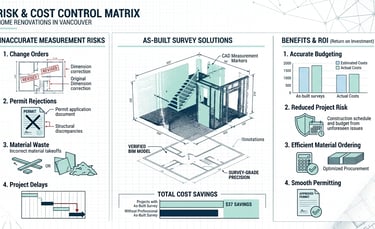
Risk & Cost Control Matrix
Inaccurate FSR / Site Coverage
Workflow Impact: Design rejected; forced redesign
Financial Exposure: $5,000–$15,000
Regulatory Impact: Permit failure
Mitigation Strategy / ROI: 3D Laser Scanning ensures exact FSR; ROI immediate
Undocumented Structural Elements
Workflow Impact: Framing halts; engineer on-site
Financial Exposure: $10,000–$30,000
Regulatory Impact: Failed inspection; Stop Work Order
Mitigation Strategy / ROI: Scan-to-BIM identifies clashes digitally
Vague Sub-trade Scopes
Workflow Impact: RFIs; stalled installation
Financial Exposure: 10–20% budget increase
Regulatory Impact: Non-compliant rough-ins
Mitigation Strategy / ROI: As-Built RCPs & sections enable fixed-price sub-trade bidding
Unpermitted Existing Work
Workflow Impact: Illegal suites discovered
Financial Exposure: Total loss; demolition
Regulatory Impact: Legal liability; Stop Work Order
Mitigation Strategy / ROI: Professional survey flags unpermitted expansions pre-construction
Implementing 3D Laser Scanning Methodology
Technical context: LiDAR scanners emit laser pulses to measure every visible surface, creating a dense point cloud
Workflow impact: Entire property mapped in a fraction of manual measurement time
Financial implications: Reduces site-visit costs and billable hours
Regulatory considerations: Accepted by municipal authorities and structural engineers
Best practice: Specify Level of Development (LOD) when commissioning Scan-to-BIM projects
Myth-Busting As-Built Surveys
Myth 1: Original blueprints are sufficient
Fact: Settling and undocumented renovations make old plans inaccurate
Myth 2: Tape measures are enough
Fact: Cannot capture out-of-square corners or floor deflection
Myth 3: As-built surveys are the same as land surveys
Fact: Land surveys map property lines; as-built surveys map the building for design and permits
FAQ: As-Built Drawings for Vancouver Renovations
1. What is an as-built drawing?
A scaled, accurate representation of a building's current condition, including walls, structural elements, and mechanical systems.
2. How does 3D laser scanning improve renovation planning?
LiDAR captures millions of precise points, creating a digital twin and eliminating human error.
3. Can inaccurate measurements really cost $50,000+?
Yes. Contractors must halt work to resolve spatial conflicts, inflating budgets by 10–20%.
4. Difference between a land surveyor and as-built company?
Land surveyor: maps property boundaries
As-built company: maps architectural and structural realities for design and permits
5. Will original house blueprints work for permits?
Generally no; municipalities require current, scaled, and accurate drawings.
6. Deliverables from as-built surveys:
Registered point cloud
2D AutoCAD DWG (Floor Plans, RCPs, Elevations)
PDF drawing sets
3D BIM model (Revit)
7. How do accurate as-builts prevent change orders?
Contractors base estimates on millimeter-accurate data, eliminating ambiguity.
8. Consequences of building without approved permits:
Severe legal and financial repercussions, including Stop Work Orders and possible demolition.
Conclusion
For Vancouver homeowners, developers, and architects, skipping professional as-built drawings is a financial and regulatory gamble. Using 3D laser scanning and Scan-to-BIM workflows:
Eliminates costly errors and delays
Ensures BC Building Code and VBBL compliance
Provides contractors with precise, verifiable data
Maximizes ROI and protects capital investment
In short, as-built surveys are not optional - they are essential for safe, efficient, and financially secure renovations in Greater Vancouver.
Contact Us
MeasureBuilt
Address
413-8188 Manitoba Street
Vancouver, BC V5X 4L8
Contacts
236-232-3335
emil@measurebuilt.com
When Details Matter!