BIM Integration in Vancouver: The Future of Construction Documentation
Learn how BIM integration Vancouver is transforming construction documentation, permitting, renovation planning, and digital construction across BC.
AS BUILT DOCUMENTATION
Emil Jordan
2/18/20264 min read
In Vancouver's high-value construction market, precision is not optional - it is operationally critical.
Between the BC Building Code, Vancouver Building By-law (VBBL), seismic requirements, and aggressive energy performance targets, projects across the Lower Mainland demand accurate, coordinated documentation from day one.
BIM services in Vancouver represent the structural shift from static 2D drafting to intelligent, data-driven modeling. This transition is not simply about producing 3D visuals. It is about creating a coordinated digital environment that reduces risk, improves compliance, and protects project margins.
Whether for a commercial retrofit downtown or a complex home renovation in Greater Vancouver, BIM has become the foundation of modern construction documentation.
The Evolution of Construction Documentation in BC
Historically, construction documentation relied on:
Manual site measurements
Redline markups
Static 2D CAD drawings
Fragmented consultant coordination
In a market like Vancouver - where cost per square foot is among the highest in Canada - small errors escalate quickly into major budget overruns.
Modern construction technology in BC has shifted toward digital integration. BIM services allow project teams to document existing conditions, design intent, and coordination within a unified model.
For aging housing stock and heritage buildings - where original blueprints rarely match reality - this accuracy is indispensable.
From Redlines to Digital Twins
Traditional redline workflows are reactive. They record problems after they occur.
BIM integration is proactive.
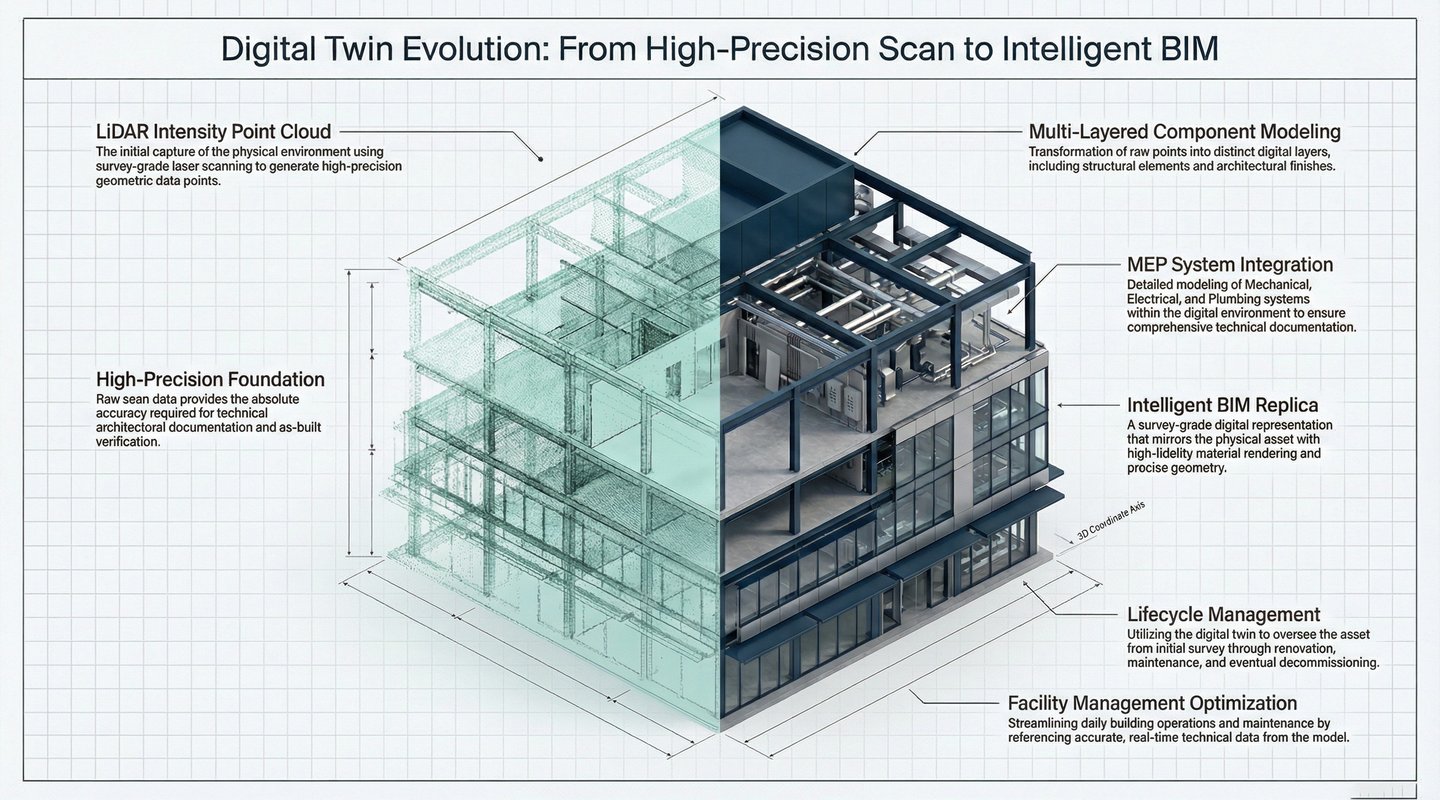
A properly developed BIM model includes:
Parametric walls, floors, and roofs
Modeled structural systems
Coordinated MEP systems
Embedded material data
This allows for:
Clash Detection
Mechanical ducts conflicting with structural beams are identified before construction - not during demolition.
Lifecycle Data Integration
BIM models can embed asset data, enabling future maintenance planning and facility management.
Collaborative Coordination
Architects, engineers, and contractors work within a single federated model rather than exchanging disconnected drawings.
In Vancouver's compressed timelines, this coordination is a competitive advantage.
The Foundation: 3D Laser Scanning and Scan-to-BIM
A BIM model is only as accurate as its source data.
Manual measurements introduce cumulative errors. Laser scanning eliminates them.
3D Laser Scanning Services
LiDAR technology captures millions of spatial data points per second, generating a high-density point cloud that reflects real-world geometry with millimeter precision.
This is particularly important for:
Seismic upgrade projects
Envelope retrofits
Industrial tenant improvements
Heritage conservation
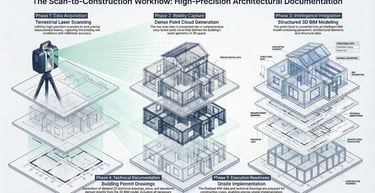
The Scan-to-BIM Workflow
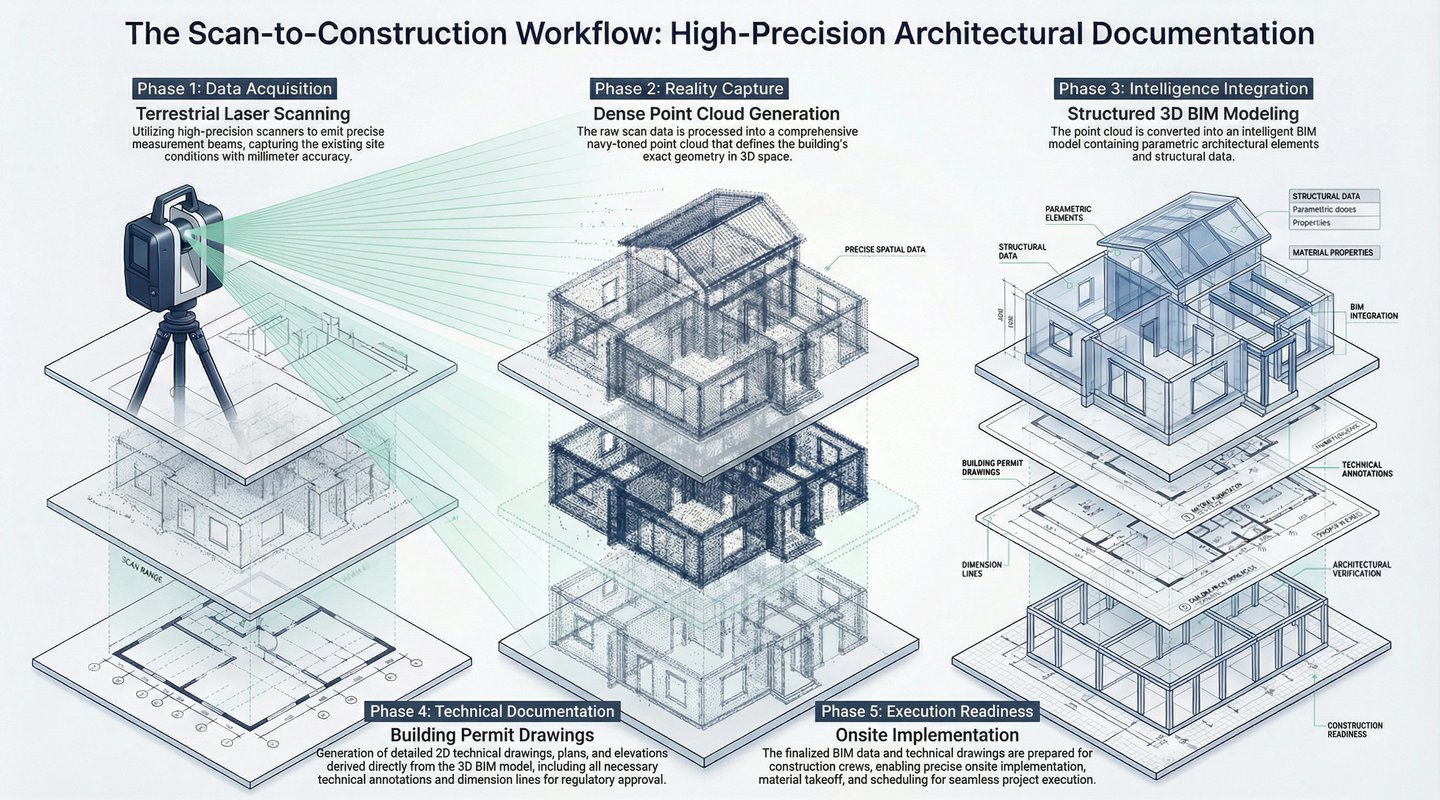
A typical BIM integration process in Vancouver follows a disciplined workflow:
1. Site Planning
Determine scanner positions to ensure full spatial coverage.
2. Data Capture
Document walls, floors, ceilings, and exposed MEP systems.
3. Point Cloud Registration
Align and clean raw scan data into a unified coordinate system.
4. BIM Modeling
Convert geometry into intelligent Revit or Archicad elements.
5. Quality Control
Cross-check tolerances and verify dimensional integrity.
The result is a model that reflects existing conditions - not assumptions.
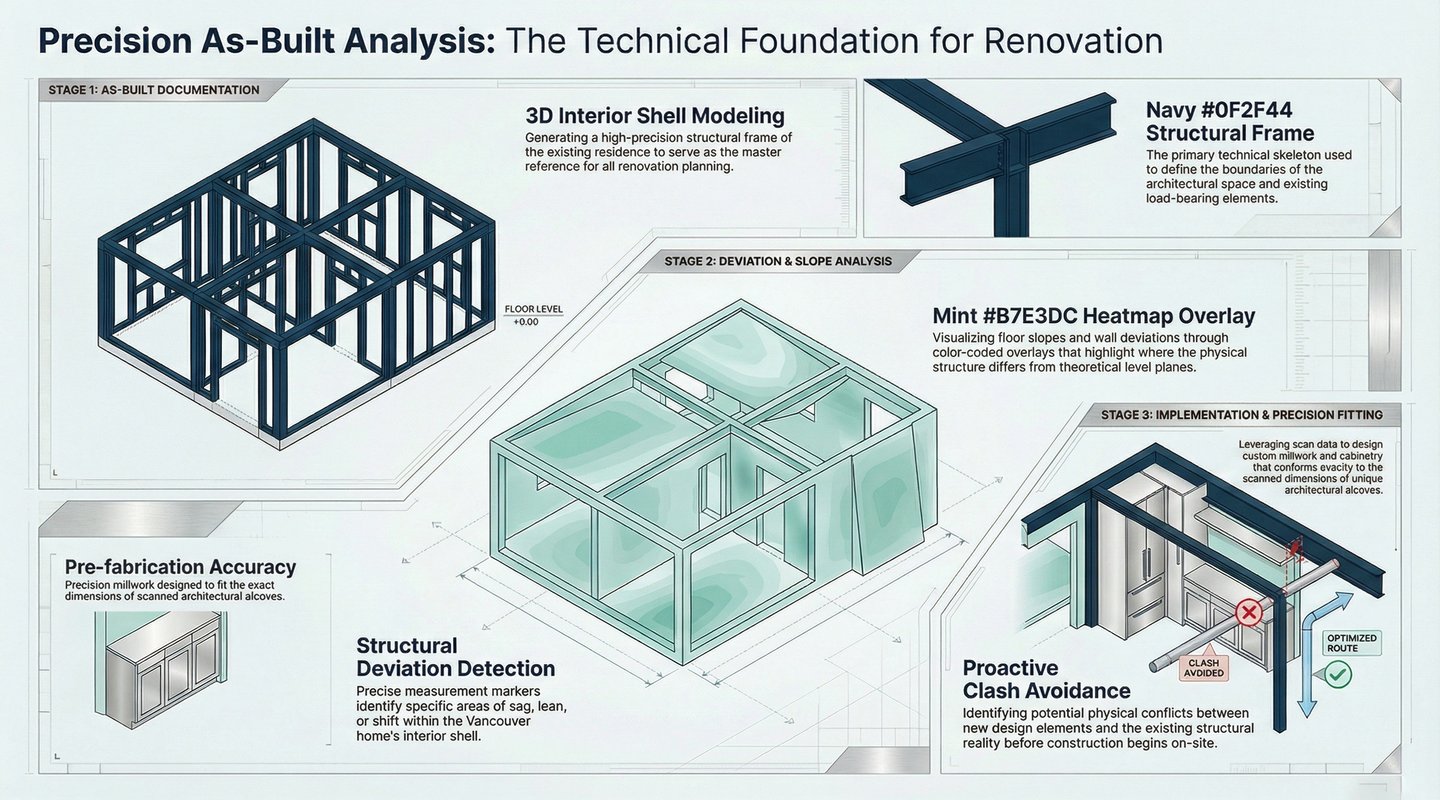
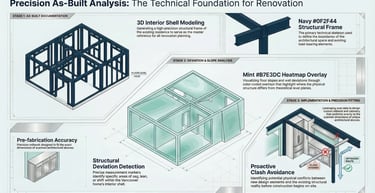
For renovation planning, this eliminates uncertainty around floor slope, beam deflection, or structural irregularities.
Navigating the BC Building Code and Vancouver Permitting
Vancouver's regulatory environment is among the most demanding in North America.
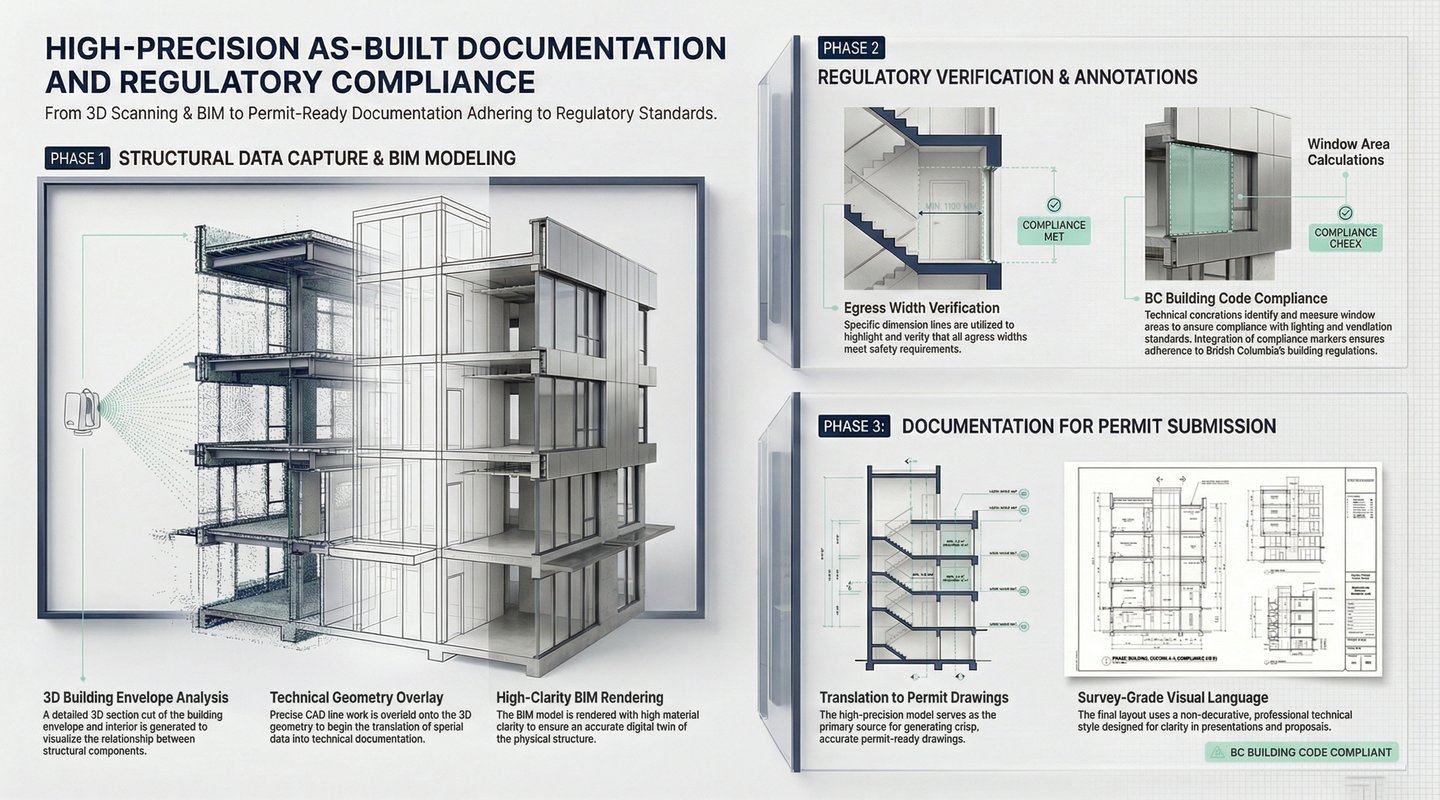
BIM supports compliance by integrating geometry with performance data.
Energy Step Code and Zero Emissions Targets
To meet Vancouver's climate goals, projects must demonstrate energy performance compliance.
BIM enables:
Energy modeling integration
Envelope performance analysis
Thermal bridge evaluation
Seismic Upgrades
In older commercial and multi-family buildings, structural engineers use BIM to:
Visualize load paths
Coordinate structural retrofits
Minimize unnecessary demolition
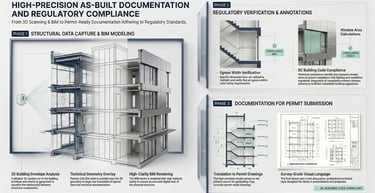
Submitting building permit drawings derived from a verified BIM model demonstrates professional diligence and reduces the likelihood of review delays.
Transforming Renovation Planning in Greater Vancouver
Home renovation projects in Greater Vancouver often uncover undocumented conditions:
Misaligned framing
Relocated plumbing
Non-permitted structural alterations
As-built to BIM workflows mitigate these risks by documenting existing conditions before design begins.
Benefits for Residential Projects
Accurate material take-offs
Reduced contractor contingency allowances
Virtual walkthroughs for client decision-making
Early conflict detection
For homeowners, BIM functions as risk insurance.
Empowering Industry Professionals
Interior Designers
Modern interior design requires vertical precision - not just floor plans.
BIM models provide:
Accurate ceiling heights
Window sill elevations
Bulkhead clearances
Structural constraints
Custom millwork, lighting layouts, and finish coordination benefit directly from verified spatial data.
Contractors
Contractor profitability depends on minimizing uncertainty.
BIM enables:
Automated quantity extraction
Precise drywall, flooring, and framing take-offs
Coordinated shop drawings
Reduced change orders
Reliable contractor estimates strengthen client trust and protect margins.
Commercial Real Estate and BOMA Compliance
For commercial properties in Vancouver, square footage is revenue.
BIM models allow:
BOMA-compliant area calculations
Verified rentable area reports
Lease transparency
In industrial and office leasing, verified measurements reduce disputes and strengthen underwriting confidence.
Understanding Level of Development (LOD)
BIM models vary in depth and application.
LOD 200
Conceptual geometry for early design.
LOD 300
Accurate geometry suitable for construction documentation and permitting.
LOD 400
Fabrication-ready detailing.
LOD 500
Field-verified as-built models for facility management.
For most Vancouver permitting and renovation projects, LOD 300 provides the optimal balance between precision and efficiency.
The Future of Digital Construction in Greater Vancouver
Looking ahead, digital construction in BC is accelerating.
Emerging trends include:
AI-Assisted Modeling
Automated recognition of walls, openings, and structural elements from point cloud data.
Automated Code Checking
Software-driven validation against BC Building Code requirements.
Persistent Digital Twins
Lifecycle-managed models updated after renovations and integrated into facility management systems.
For strata corporations and commercial owners, this represents a long-term asset management shift - not just a design tool.
Conclusion: BIM as Strategic Infrastructure
BIM integration in Vancouver is not a luxury upgrade. It is strategic infrastructure for modern construction.
In a market defined by high costs, regulatory complexity, and compressed schedules, the ability to:
Document existing conditions precisely
Coordinate systems digitally
Extract reliable quantities
Support permit compliance
is essential.
For homeowners, it means renovations grounded in reality.
For contractors, it means controlled risk.
For developers and asset managers, it means long-term operational clarity.
Accurate data is the foundation of successful project delivery.
In Vancouver's evolving construction landscape, BIM is no longer the future. It is the standard.
Contact us
MeasureBuilt
Address
413-8188 Manitoba Street
Vancouver, BC V5X 4L8
Contacts
236-232-3335
emil@measurebuilt.com
When Details Matter!