3D Scanning Trends Vancouver: As-Built Surveys & BIM
Explore 3D scanning trends Vancouver is adopting for as-built surveys, Scan-to-BIM workflows, renovation planning, and BC Building Code compliance.
3D SCANNING
Emil Jordan
2/13/20264 min read
The architecture, engineering, and construction (AEC) industry in British Columbia is undergoing structural transformation. Rising construction costs, regulatory scrutiny, labor shortages, and compressed project timelines are forcing professionals to eliminate uncertainty wherever possible.
Traditional manual measurement methods - tape measures, distos, hand sketches - are no longer sufficient for high-value assets. In their place, reality capture technologies powered by LiDAR and integrated into Building Information Modeling (BIM) workflows are becoming the operational standard.
In Vancouver, this shift is particularly pronounced. From industrial leasing due diligence to complex home renovations in Greater Vancouver, precision is no longer optional - it is a risk management strategy.
The Current State of Construction Technology in Canada
Canada has historically adopted digital construction technologies more conservatively than parts of Europe and Asia. That gap is narrowing rapidly.
Key drivers include:
Skilled labor shortages
Increased litigation risk
Demanding municipal review processes
Tight financing and lender oversight
Higher expectations for cost certainty
The industry is transitioning from 2D documentation toward data-driven 3D intelligence. As-built surveys are evolving from static drawings into dynamic datasets.
From 2D Drafting to 3D Intelligence
Traditional surveys often miss critical realities:
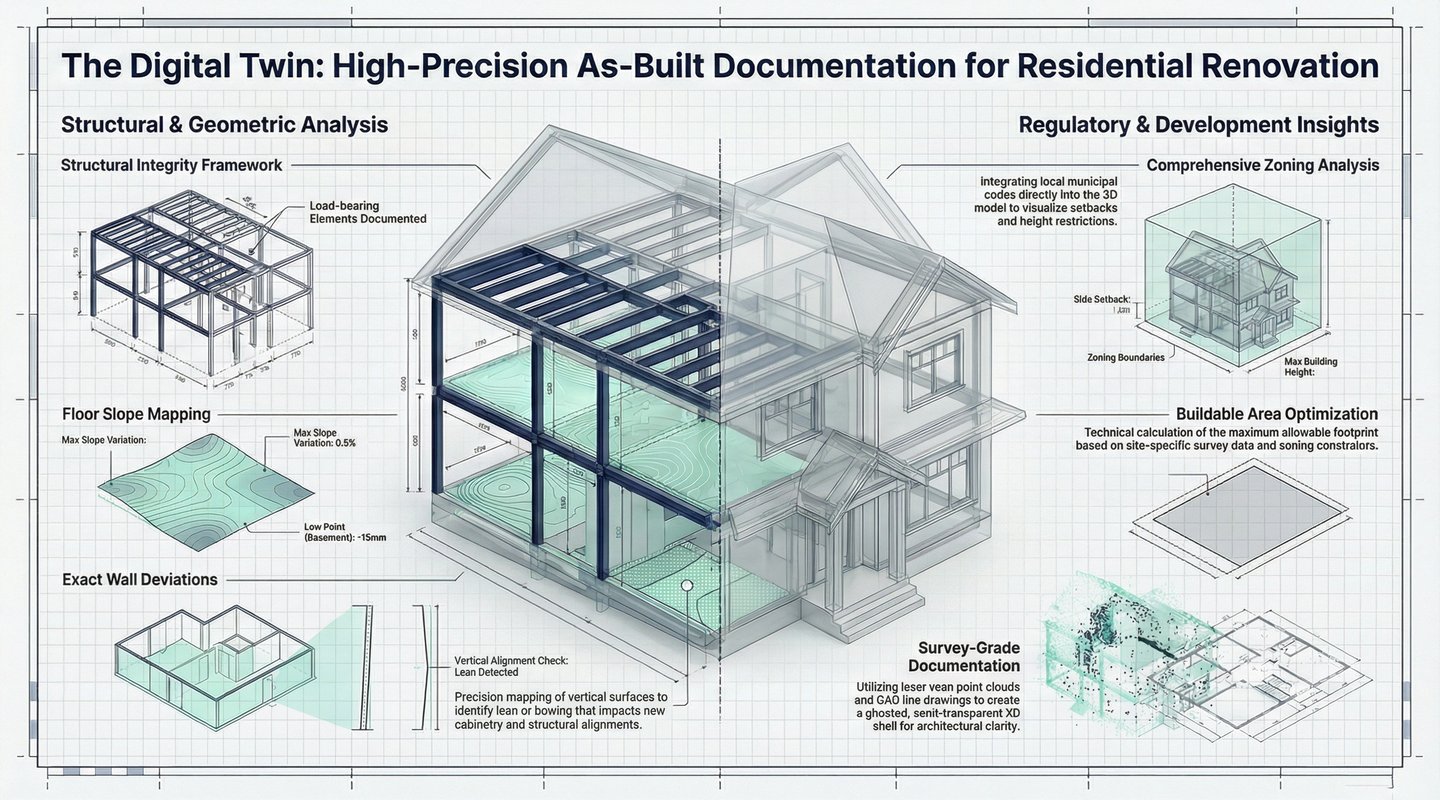
Wall deviations
Slab deflection
Structural irregularities
MEP conflicts
Envelope distortion
Manual measurement introduces sampling risk. You measure what you can see and reach - but not necessarily everything that matters.
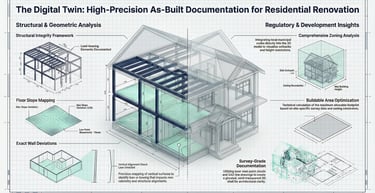
3D laser scanning eliminates sampling bias by capturing millions of spatial data points. The result is a high-density point cloud - a digital twin of the existing structure.
In dense urban environments like Vancouver, where heritage preservation, zoning constraints, and high land values intersect, precise geometry directly affects project viability.
Why 3D Laser Scanning Is Replacing Traditional Surveying
1. Precision at Scale
Modern terrestrial LiDAR scanners capture millimeter-level accuracy. Mobile SLAM-based systems can document up to 150,000 square feet per day.
Unlike legacy drawings - which reflect design intent - laser scanning documents existing reality.
That distinction is critical in:
Industrial acquisitions
Tenant improvements
Renovation planning
Envelope retrofits
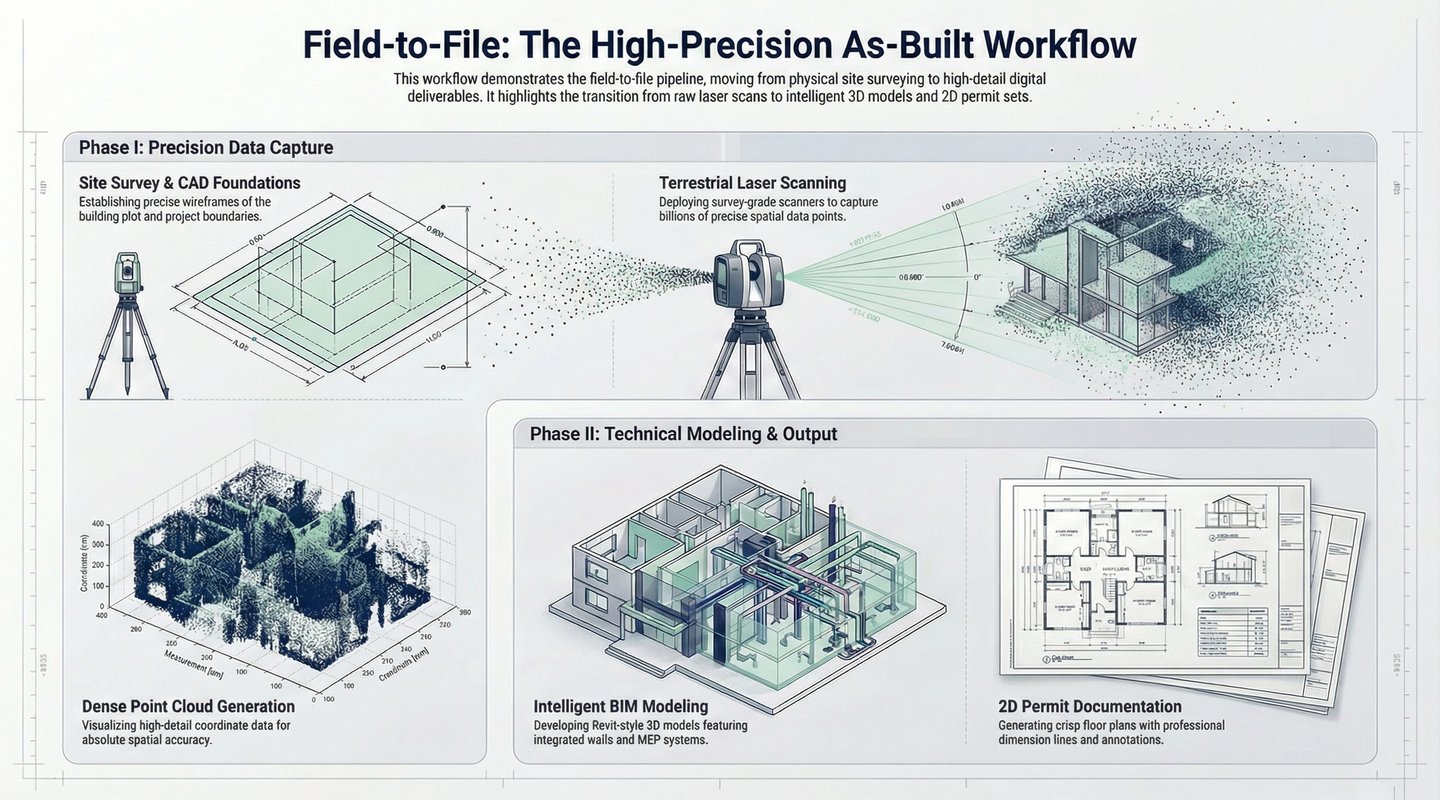
2. The "Field-to-File" Workflow
A growing 3D scanning trend in Vancouver is the field-to-file workflow:
1. Capture entire structure digitally
2. Register and clean point cloud
3. Model in CAD or BIM
4. Produce permit-ready documentation
No assumptions. No back-check site visits. Reduced change orders.
For renovation-heavy markets like Greater Vancouver, this workflow significantly reduces construction-phase surprises.
Key 3D Scanning Trends in Vancouver
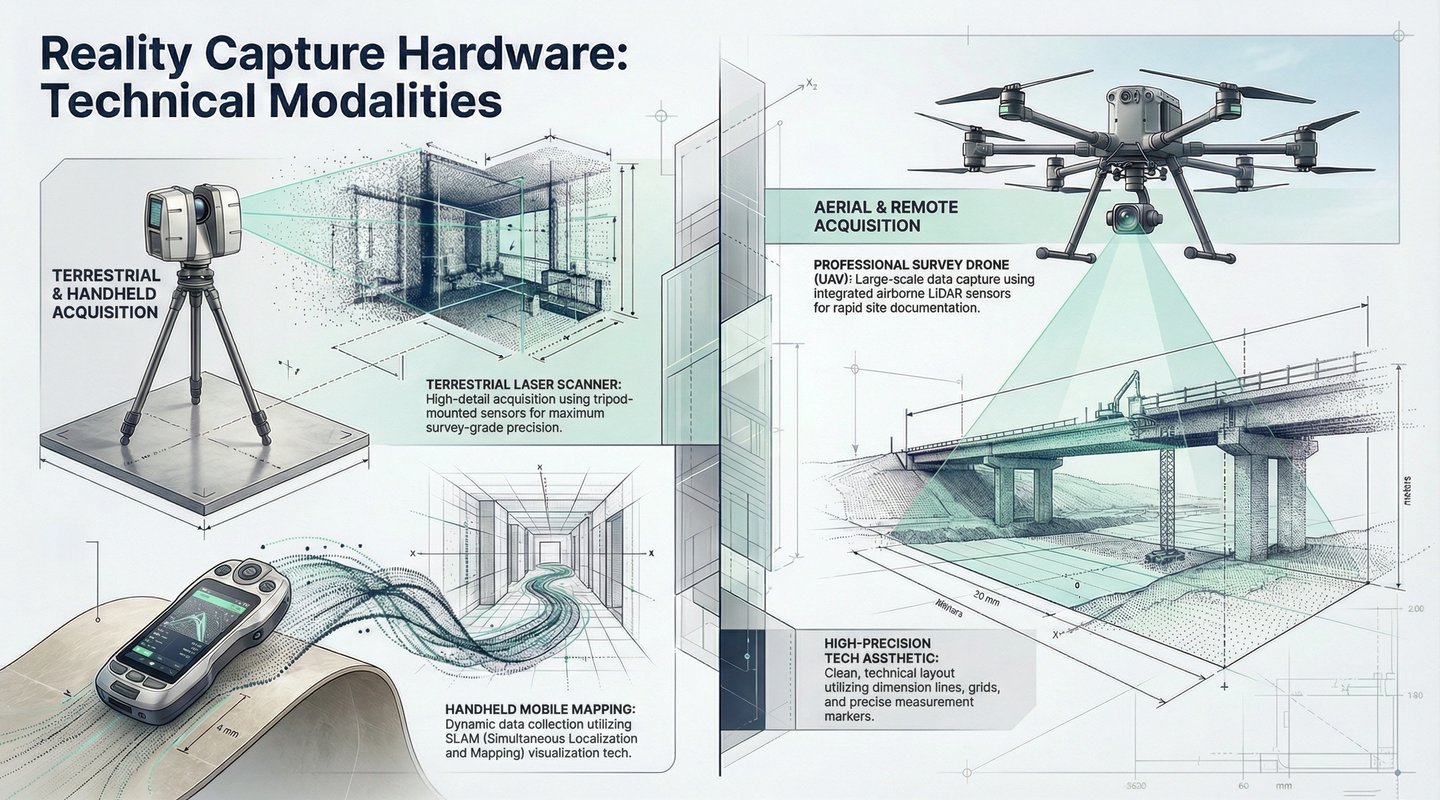
Mobile Mapping and SLAM
While static terrestrial scanners remain the gold standard for high-accuracy deliverables, SLAM-based mobile systems are increasingly used for:
Large industrial facilities
Warehouses
Real estate marketing floor plans
Rapid due diligence scans
These systems prioritize speed and coverage while maintaining acceptable accuracy tolerances for leasing and planning purposes.
Drone Integration for Exterior Capture
Unmanned Aerial Vehicles (UAVs) are now routinely integrated into building surveys.
Applications include:
Roof condition documentation
Façade inspection
Site context modeling
Hard-to-access envelope conditions
Combined with terrestrial scans, drones create a complete building dataset.
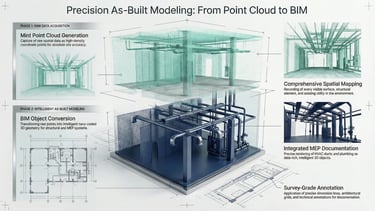
Scan-to-BIM Workflows
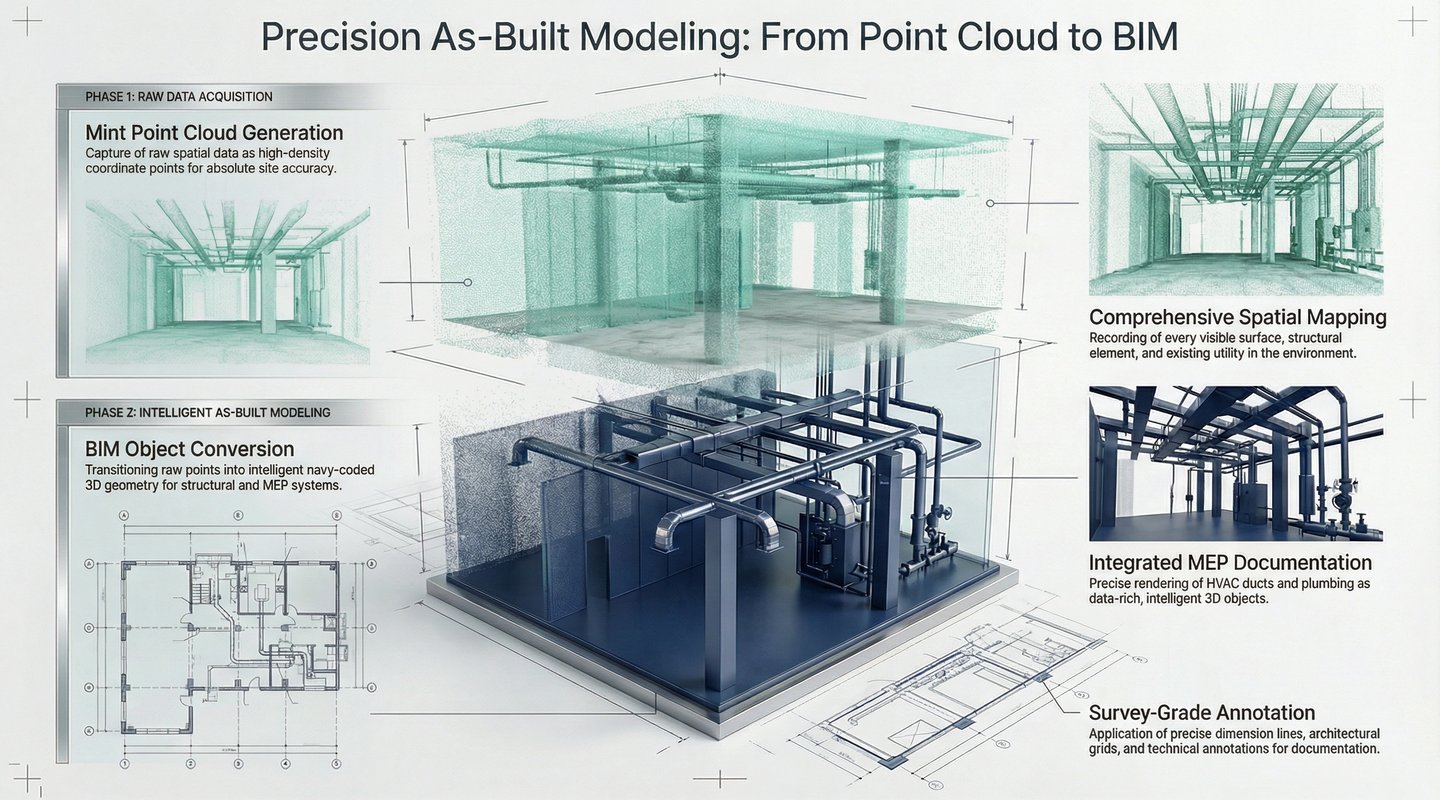
Scan-to-BIM is the most consequential development in reality capture.
Instead of delivering only 2D CAD drawings, professionals now generate intelligent BIM models (typically in Revit), where:
Walls are parametric objects
Floors contain thickness data
Pipes carry diameter information
Openings are embedded within assemblies
Benefits include:
Clash detection before construction
Accurate quantity take-offs
Retrofit planning
Energy modeling
Facility management integration
This is driving the rise of BIM as-built standards across Canada.
BIM As-Built in Canada: A New Renovation Standard
An as-built BIM model represents a structure at a specific moment in time, reflecting real-world conditions - not design assumptions.
For Home Renovation in Greater Vancouver
The region's aging housing stock often lacks reliable drawings. Renovation begins with uncertainty.
A 3D scan provides:
Verified structural geometry
Accurate floor areas
Envelope measurements
Non-invasive verification
This enables:
Off-site prefabrication
Millwork precision
Structural planning without demolition risk
In high-cost markets, eliminating unknowns protects both schedule and margin.
BOMA Standards and Commercial Measurement
In commercial real estate, square footage equals revenue.
3D laser scanning services are increasingly used to certify measurements in accordance with BOMA Industrial and BOMA Office standards.
Benefits include:
Accurate rentable area calculations
Lease dispute mitigation
Revenue optimization
Lender-grade documentation
In industrial acquisition due diligence, verified area data directly influences underwriting.
From Point Cloud to Permit Drawings
A scan is not the final deliverable. It is raw spatial data.
Professional interpretation converts point clouds into:
2D as-built floor plans
Elevations and sections
Reflected ceiling plans
Fully modeled BIM environments
For Vancouver permit submissions, accuracy is critical. Plan reviewers require:
Correct egress widths
Window area compliance
Occupancy calculations
Clear height documentation
Reality capture ensures drawings reflect actual site conditions, not assumptions.
Business Case for Designers, Contractors, and Brokers
Interior Designers
For interior designers, the shell must be exact.
Scan-derived models allow:
Precise furniture layouts
Lighting coordination
Custom millwork fabrication
VR visualization
Irregular walls and legacy construction are no longer design constraints.
Contractors
Contractor estimates often include contingencies to cover unknown site conditions.
With 3D scanning:
Material take-offs are automated
Structural conflicts are visible early
Mechanical rerouting can be planned pre-demolition
The result: tighter bids and reduced change orders.
Real Estate Professionals
In Vancouver's competitive market, accurate floor plans protect liability exposure.
Laser-derived plans provide:
Verified square footage
Marketing-grade floor plans
Digital twin tours
Increased buyer trust
Accuracy is not just technical - it is reputational.
Technical Overview: The Scan-to-BIM Workflow
For industry professionals evaluating adoption:
1. Pre-Scan Planning
Determine scanner positions to minimize occlusion and maximize coverage.
2. Data Capture
LiDAR measures distance using time-of-flight laser pulses.
3. Registration
Individual scans are stitched into a unified coordinate system.
4. Processing & Cleaning
Noise reduction and alignment refinement.
5. Modeling
Import into Revit or CAD platforms for object-based modeling.
6. Quality Assurance
Cross-check measurements and tolerances.
The integrity of each stage determines final deliverable reliability.
The Future: AI and Digital Twins in Vancouver
The next evolution of 3D scanning trends in Vancouver includes:
AI-Assisted Modeling
Machine learning algorithms are beginning to auto-detect:
Walls
Doors
Windows
Structural members
This reduces modeling time and increases consistency.
Persistent Digital Twins
Buildings are moving toward lifecycle-based digital records:
Updated after renovations
Integrated with facility management systems
Used for predictive maintenance
Reality capture is becoming a permanent asset - not a one-time survey.
Conclusion: Precision as Competitive Advantage
Vancouver's construction and real estate markets are too capital-intensive to rely on approximation.
3D laser scanning and BIM-based as-built documentation represent a structural shift toward certainty.
Whether for:
Industrial leasing
Tenant improvements
Permit submissions
Renovation planning
Commercial underwriting
The future belongs to those who build from verified reality - not assumptions.
Precision is no longer a technical upgrade. It is a business strategy.
Ready to Future-Proof Your Projects?
Contact MeasureBuilt today to discover how our advanced 3D scanning and BIM services can position your Vancouver projects at the forefront of construction technology.
MeasureBuilt: Where Details Matter
Contact us
MeasureBuilt
Address
413-8188 Manitoba Street
Vancouver, BC V5X 4L8
Contacts
236-232-3335
emil@measurebuilt.com
When Details Matter!