3D Laser Scanning vs. Traditional Measuring in Vancouver
Discover why 3D laser scanning is replacing traditional measuring in Vancouver. Learn about its accuracy for BIM, renovations, and heritage preservation.
3D SCANNING
Emil Jordan
2/3/20266 min read
The construction and real estate landscape in British Columbia is undergoing a profound transformation, driven by the demand for absolute precision and the increasing complexity of modern architectural designs. For decades, the industry relied on tape measures, laser distance meters, and manual sketches to document existing conditions. However, as 3D laser scanning in Vancouver becomes the new benchmark for accuracy, professionals are realizing that traditional methods simply cannot compete with the data density and reliability of Light Detection and Ranging (LiDAR) technology.
Whether you are an architect retrofitting a heritage building in Gastown or a homeowner planning a major renovation in Kitsilano, understanding the shift from manual measurement to digital reality capture is essential for project success.
The paradigm shift: understanding 3D laser scanning in Vancouver
In the high-stakes environment of the Lower Mainland's property market, the margin for error is non-existent. 3D laser scanning in Vancouver represents a technological leap that replaces manual interpretation with hard data. Unlike a surveyor using a total station or a contractor with a tape measure - who captures single points one at a time - a 3D laser scanner captures millions of data points per second.
This creates a "point cloud," a dense digital replica of the physical space that maps every surface, edge, and geometric irregularity with millimeter-level precision.
The limitations of traditional surveying
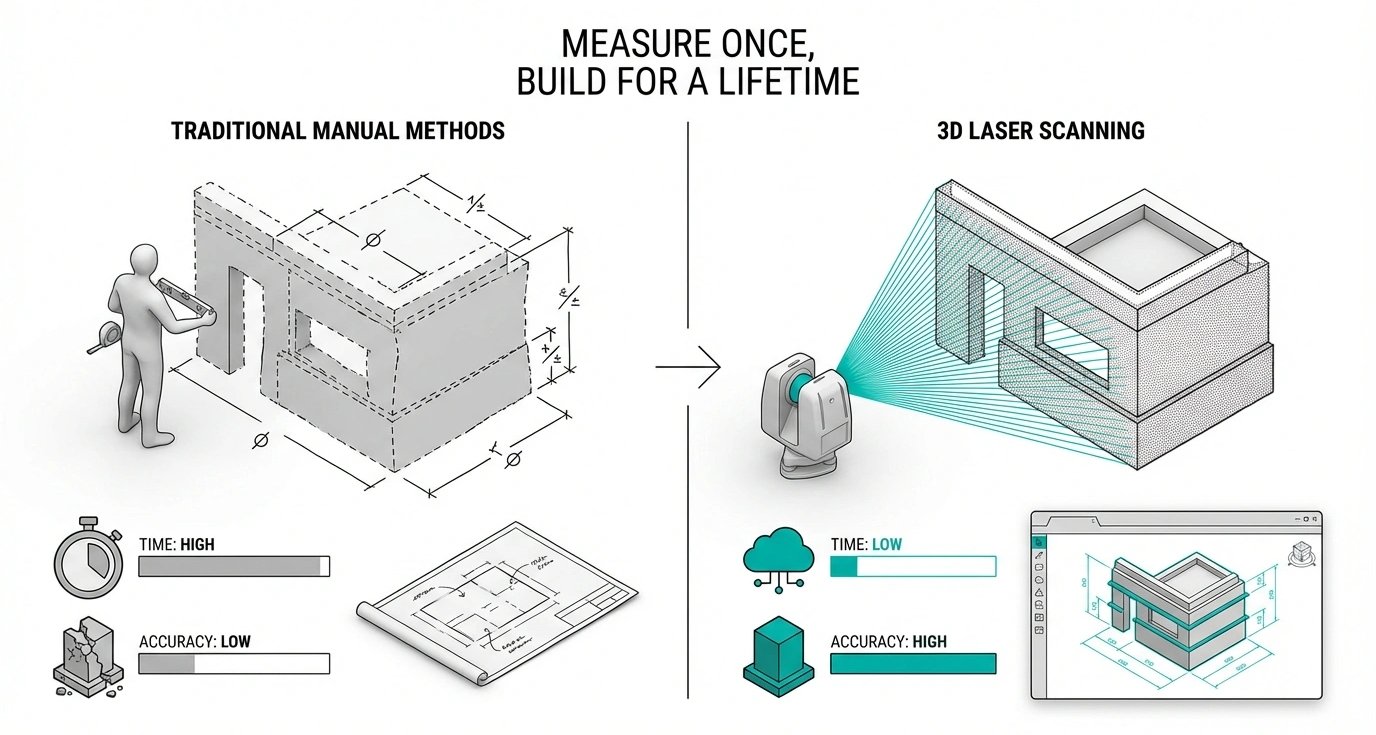
To appreciate the revolution, we must acknowledge the limitations of the past. Traditional surveying relies heavily on manual instruments and human recording. While tools like total stations are fundamental for land development, they are often labor-intensive and time-consuming when applied to complex building interiors.
The traditional workflow is fraught with potential pitfalls:
Human error: manual measurements are susceptible to reading errors, transcription mistakes, and the "human factor" of interpreting where a wall starts or ends.
Incomplete data: a tape measure only records what you decide to measure. If a beam is missed or a ceiling height is assumed to be uniform when it is actually sloped, the resulting construction documentation will be flawed.
Site accessibility: traditional methods require physical access to every point being measured, posing safety risks when measuring high ceilings or unstable structures.
Comparative analysis: accuracy, speed, and efficiency
For stakeholders in the AEC (Architecture, Engineering, and Construction) industry, the choice between 3D laser scanning in Vancouver and traditional methods often comes down to the "iron triangle" of project management: time, cost, and quality.
Unmatched accuracy and precision
Precision is paramount in surveying, and 3D laser scanning excels where manual methods falter. While a good manual survey might be accurate to within a few centimeters, 3D laser scanning services consistently deliver accuracy within millimeters. This is critical in Vancouver, where property lines are tight and density is high.
This level of precision is vital for generating accurate floor plans. In older Vancouver homes, walls are rarely perfectly square. A manual measurement might "idealize" these features, leading to design errors later. A laser scan reveals the truth, allowing architects to design around the actual conditions.
Speed of data collection
Time is a critical resource in the construction industry. 3D laser scanning services can reduce data collection time by up to 50% compared to traditional methods.
Rapid coverage: a laser scanner can record millions of points per second, covering complex areas in a fraction of the time required for manual measurement.
Reduced site visits: because the scanner captures everything in its line of sight, the need for return visits to measure a forgotten dimension is virtually eliminated.
Safety and accessibility benefits
In the challenging terrain of British Columbia, from steep slopes in West Vancouver to industrial sites in Burnaby, safety is a major concern. Laser scanning allows professionals to capture data remotely. An operator can scan a crumbling facade or a high-voltage electrical substation from a safe distance, significantly mitigating safety risks.
Transforming renovation planning and home renovation in Greater Vancouver
The retrofit and renovation market is a massive sector in British Columbia. Home renovation projects in Greater Vancouver are particularly sensitive to the quality of as-built drawings.
The "zero rework" strategy
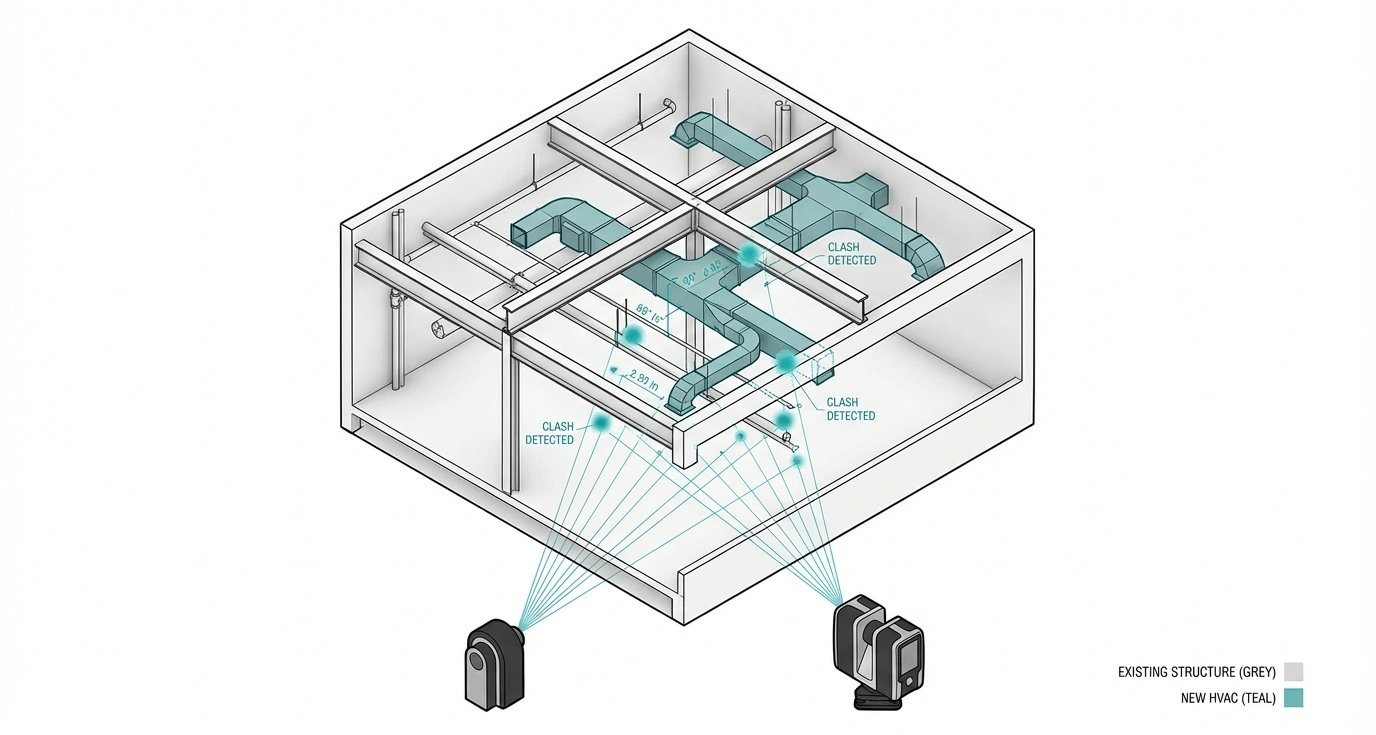
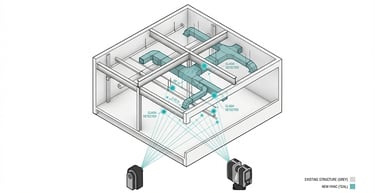
One of the most costly phrases in construction is "it doesn't fit." In traditional workflows, contractors often encounter surprises when new prefabricated components arrive on site and clash with existing mechanical systems. Using 3D laser scanning services enables a "zero rework" strategy. By verifying as-built conditions against design intent in a 3D model, contractors can perform clash detection - for example, verifying if a new HVAC run will hit an existing structural beam.
Interior designer tools and visualization
For interior designers, the point cloud is a game-changer. It provides a foundation for creating crucial interior designer tools such as virtual walkthroughs and photorealistic renders.
Complex geometries: scanning captures irregular features like curved walls and custom millwork that are notoriously difficult to measure by hand.
Material estimation: the precision of the scan allows for exact calculation of material needs, reducing waste and ensuring more accurate contractor estimates.
From scan to BIM: the future of construction documentation
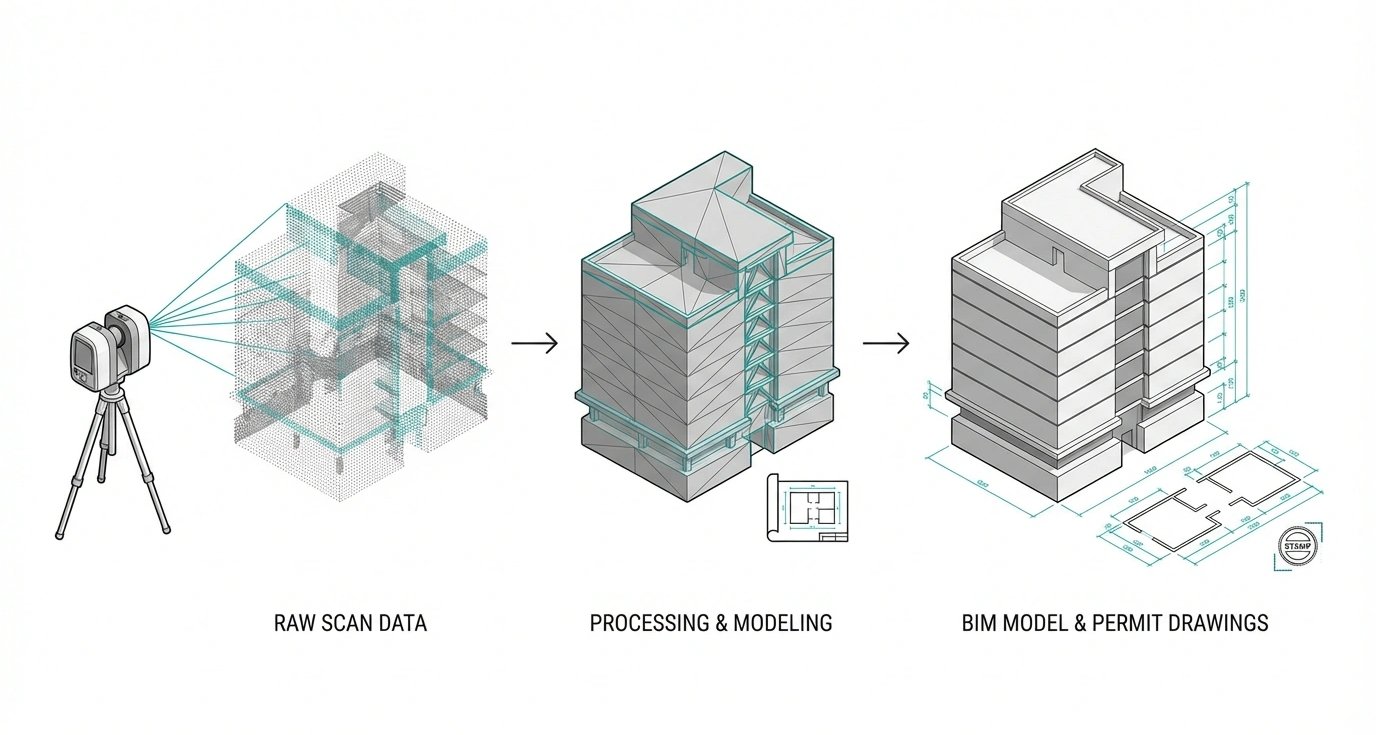
The raw output of a laser scan is a point cloud, but the true value lies in converting that data into usable construction documentation, a process known as "Scan to BIM."
Streamlining building permit drawings
In the City of Vancouver, obtaining a building permit requires strictly adherent documentation. Submitting building permit drawings based on vague manual measurements can lead to rejection and delays. 3D laser scanning providers can generate "digital twins" that serve as the single source of truth, allowing for the extraction of:
2D floor plans: exact layouts showing current wall thicknesses.
Elevations and sections: slices through the building that reveal vertical relationships.
Reflected ceiling plans: crucial for lighting and mechanical coordination.
BC Building Code compliance
Compliance with the BC Building Code is non-negotiable. Whether calculating the rise and run of a heritage staircase or determining the glazed area of a facade, data from a 3D scan provides the forensic level of detail required for code analysis. This is particularly relevant for "change of use" projects requiring a rigorous feasibility scan.


Real estate and property management applications
The utility of 3D laser scanning in Vancouver extends beyond construction into real estate sales and property management.
The RMS vs. architectural measurement debate
In the real estate world, accurate square footage is currency. Discrepancies often arise between different measurement standards (RMS vs. Architectural). Real estate floor plans derived from laser scanning provide an objective, indisputable dataset. If a dispute arises regarding the leasable area (BOMA standards), the point cloud serves as a forensic record that can be re-measured without re-visiting the property.
Heritage preservation: digitizing Vancouver's history
Vancouver takes pride in its heritage structures, from the Victorian homes of Strathcona to the brick warehouses of Yaletown. 3D laser scanning in Vancouver is the preferred method for heritage documentation because it is non-intrusive. Scanners can capture intricate details of cornices and masonry patterns, creating a "digital archive" for faithful restoration.
The cost-benefit analysis: is it worth it?
A common hesitation among property owners is the perceived cost of 3D laser scanning services. While the upfront cost is higher than a manual survey, this view is myopic.
The cost of error
Consider the cost of a single error in renovation planning. If a custom staircase is ordered based on a measurement off by 25 mm, the cost of the delay and material waste far exceeds the cost of the initial scan. By providing accurate contractor estimates and reducing change orders, laser scanning is an insurance policy against the unknown.
Choosing the right 3D laser scanning provider in Vancouver
Not all scanning is created equal. When selecting a partner, look for providers who understand both the technology and the local construction environment.
Equipment quality: ensure the provider uses high-end terrestrial scanners (like Leica or Trimble) rather than consumer-grade tools.
Deliverable formats: ensure they can provide the specific file types you need (RCP for Revit, DWG for AutoCAD, or PDF).
Experience: look for teams with a track record in home renovation in Greater Vancouver or commercial retrofits.
Contact us
MeasureBuilt
Address
413-8188 Manitoba Street
Vancouver, BC V5X 4L8
Contacts
236-232-3335
emil@measurebuilt.com
When Details Matter!