3D Laser Scanning in Vancouver: Precision for AEC Projects
Elevate your project with 3D laser scanning in Vancouver. Get millimeter-accurate as-built data, reduce risks, and streamline Scan-to-BIM workflows today.
3D SCANNING
Emil Jordan
1/28/20267 min read
In the fast-moving world of architecture, engineering, and construction (AEC), accuracy is not just a preference - it is an absolute requirement. Whether you are a property owner planning a major home renovation or a professional managing a complex commercial retrofit, every successful project begins with a clear understanding of a building's existing conditions. Today, 3D laser scanning in Vancouver has revolutionized as-built measurements by leveraging cutting-edge LiDAR (light detection and ranging) systems and Scan-to-BIM workflows. By capturing millions of precise data points within minutes, professionals can now create a digital foundation for accurate floor plans, building permit drawings, and complex construction documentation.

The evolution of as-built measurements in the AEC industry
Historically, as-built measurements were taken manually using tape measures, rulers, and hand-drawn sketches. While these methods served their purpose for decades, they were inherently time-consuming, prone to human error, and limited in their overall scope. In our ten years of providing 3D laser scanning services, we have learned that the biggest client concern isn't actually about the technology - it is about trust. An architect designing a multi-million-dollar hospital renovation needs to be certain that the documentation they are working from is flawless.
Outdated blueprints and manual measurement errors are not just inconvenient; they lead to costly rework, project delays, and significant financial risk. Traditional building measurements rely on rough sketches and hours of on-site work that often result in discrepancies. 3D laser scanning in Vancouver replaces this uncertainty with precision, capturing detailed information about a building's layout in a remarkably short amount of time.
Across Vancouver and the Greater Vancouver Area, reality capture technologies provide faster, safer, and more reliable documentation for interior designers, contractors, and property managers. We are seeing a permanent shift in how the industry documents existing conditions, moving away from antiquated tools and toward a digital-first approach.
Understanding the technology: how a 3D scanner in Vancouver works
At its core, 3D laser scanning - also known as high definition surveying (HDS) - is a non-contact, non-destructive method of mapping surfaces. A professional 3D scanner in Vancouver works by firing thousands, or even millions, of laser pulses per second at physical surfaces. These pulses bounce back to the scanner, where sensors calculate the "time-of-flight" and the angle of return to determine precise spatial coordinates.
LiDAR vs. traditional surveying
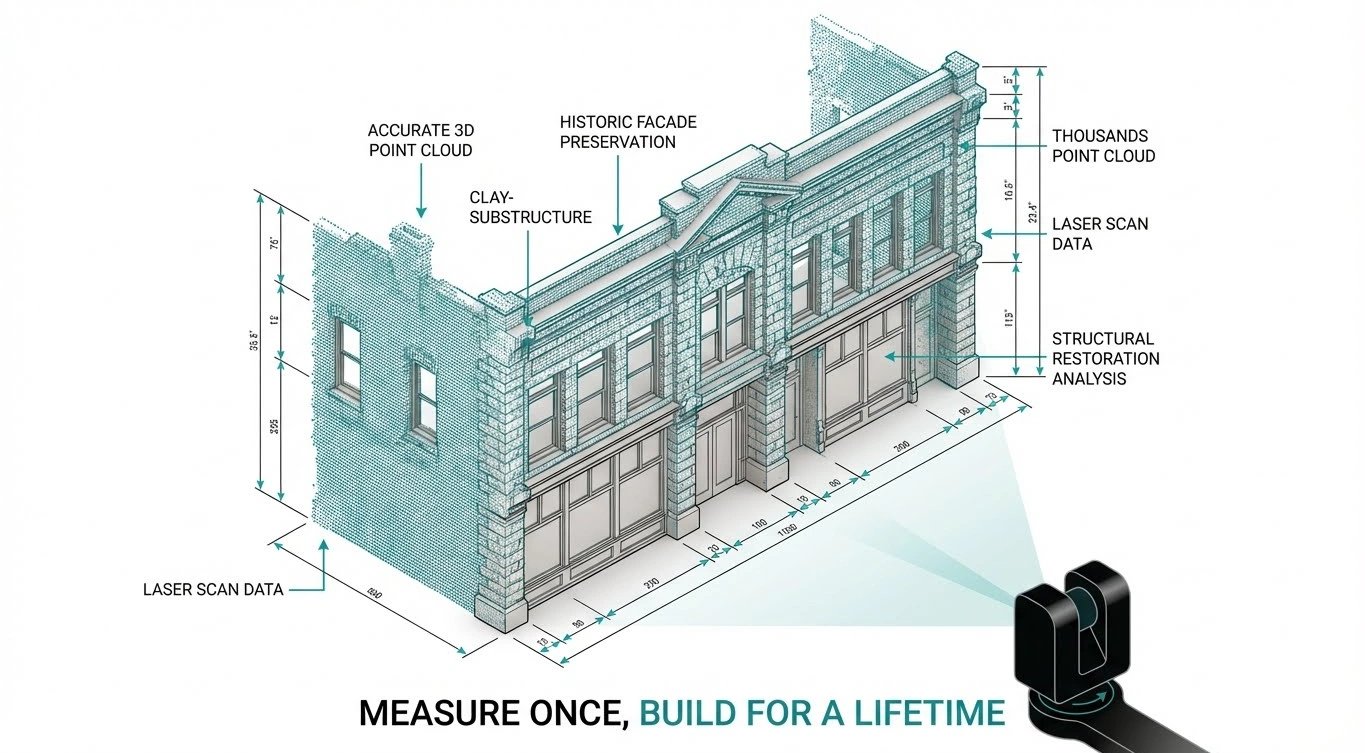
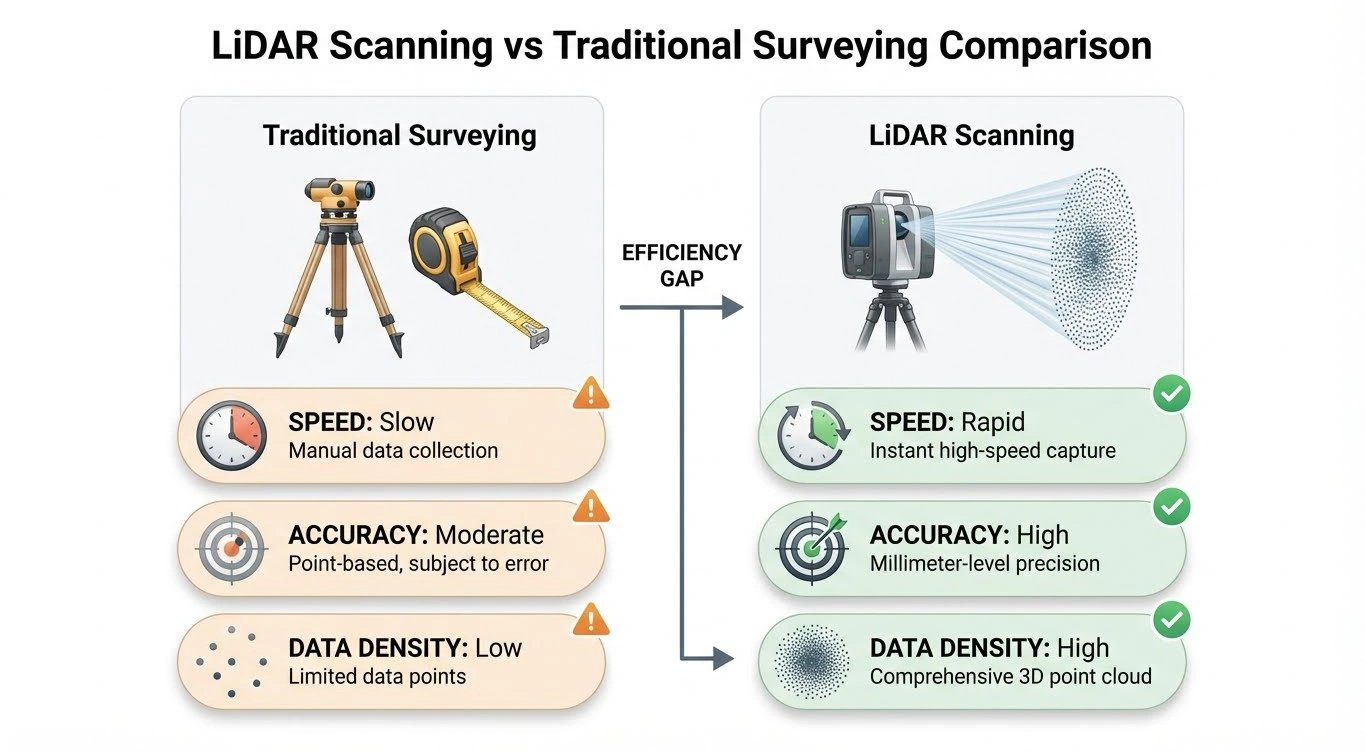
LiDAR is the underlying technology that measures distance by illuminating a target with laser light. When these measurements are combined, they create a point cloud - a dense collection of millions of individual data points, each with its own x, y, and z coordinate. Unlike a simple photograph, this point cloud provides a millimeter-accurate digital replica of the real-world asset.
While traditional tools like total stations provide high accuracy, they require significant setup time and point-by-point manual selection. In contrast, a modern terrestrial 3D scanner in Vancouver captures the entirety of an environment, ensuring that no critical architectural or structural detail is omitted. This technology allows us to capture the "snapshot of current conditions" with the highest resolution of measurable detail currently available to engineering projects.
The benefits of professional 3D laser scanning services
Choosing professional 3D laser scanning services over traditional methods offers tangible benefits that directly impact a project's bottom line. The investment in a 3D scan often pays for itself many times over by providing accurate data upfront and helping teams avoid delays.
Millimeter-level accuracy
The primary advantage of building scanning is unmatched precision. Professional systems can deliver data typically accurate to within 1-5 mm, eliminating the guesswork associated with manual measurements. This level of detail is critical when retrofitting new equipment into tight spaces or when regulatory compliance depends on exact dimensions.
In Vancouver, where many homes and commercial buildings are older or complex, subtle deviations - like warped walls or offset windows - can be captured with precision. This allows professionals to detect deviations between the "as-built" condition and the original "as-designed" CAD models through color-coded analysis.
Reducing fieldwork and site visits
3D laser scanning in Vancouver can reduce fieldwork time by up to 70%. A single technician can scan tens of thousands of square feet in a day, a task that would take a traditional survey crew weeks. This efficiency limits the number of times a measurement team needs to revisit a site, which is especially valuable for active facilities like hospitals or retail stores.
Furthermore, having a complete environment capture allows architects and designers to "virtually visit" a site from their office. These virtual walkthroughs are an interior designer's tools of choice, allowing them to verify measurements or view architectural details without leaving their desk.
Enhanced safety and accessibility
Laser scanning is a non-contact technology, allowing data capture from a safe distance. This is crucial when documenting hazardous areas, high ceilings, or inaccessible structures such as steep cliffs or busy intersections. In industrial settings, scanners can document zones without putting personnel at risk, such as near high-voltage electrical facilities or in confined spaces.
The Scan-to-BIM workflow: a roadmap to precision
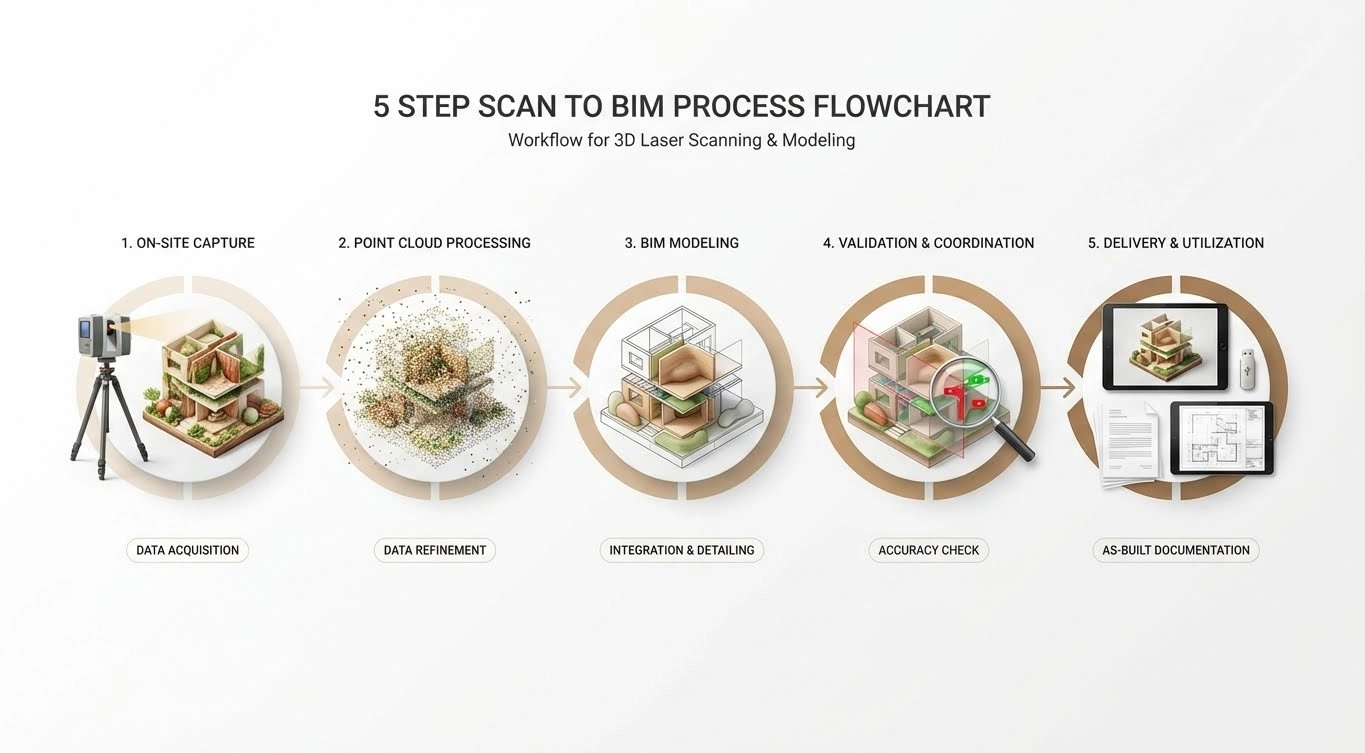
Transforming raw scan data into actionable insights involves a structured five-step process that ensures quality and consistency.
1. Project consultation and planning: Every project starts with a detailed consultation to understand the client's goals and define the required scope. This planning phase is essential for renovation planning, as it helps establish the "single source of truth" for the entire project team.
2. On-site data capture: Technicians deploy to the site with state-of-the-art equipment to systematically scan the area, ensuring complete coverage and overcoming shadows.
3. Data processing: Individual scans are cleaned, aligned, and "registered" into a unified point cloud. Specialized software filters out "noise" to ensure geometric integrity.
4. Modeling and deliverable creation: The modeling team transforms the point cloud into the desired deliverable, meticulously mapping data to BIM objects to create accurate floor plans.
5. Quality control and final delivery: Every deliverable undergoes rigorous checks to ensure accuracy before delivery in preferred formats.
Beyond 2D: the power of building scanning for BIM and digital twins
While 2D drawings are still widely used, the industry is rapidly moving toward building information modeling (BIM). Scan-to-BIM is the process of converting point cloud data into an intelligent, data-rich 3D model.
Unlike a simple 3D model that only shows geometry, a BIM model includes metadata on materials, costs, and lifecycle information. These models are essential for:
Clash detection: identifying conflicts between new designs and existing systems.
Design validation: ensuring prefabricated components fit perfectly.
Digital twins: creating interactive replicas for facility management.
In the context of renovation planning, Scan-to-BIM significantly reduces errors and allows stakeholders to work from a shared knowledge resource throughout the building's lifecycle.
Applications across Vancouver's built environment
The versatility of 3D laser scanning in Vancouver makes it an indispensable asset across multiple sectors in British Columbia.
Home renovation in Greater Vancouver and residential projects
For a home renovation in Greater Vancouver, precision is the backbone of success. Accurate as-built documentation ensures that building permit drawings reflect actual site conditions, which is a requirement for local approvals. Homeowners and interior designers use these scans to fit custom cabinetry and fixtures without the fear of manual measurement errors. We have provided services for everything from single-family homes to large multi-family condo renovations, ensuring that every architectural detail is captured.
Heritage buildings and historic preservation
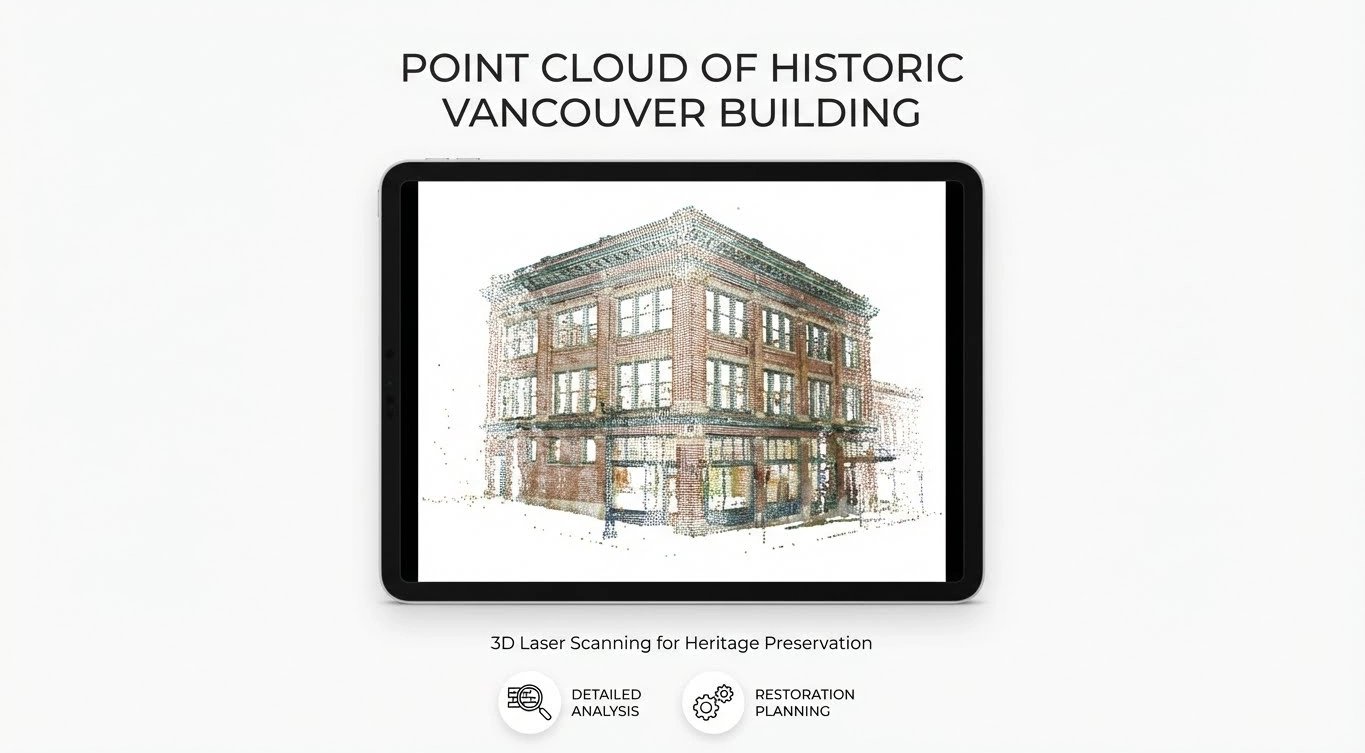
Vancouver's heritage properties require a sensitive, non-invasive approach to documentation. 3D scanning allows us to capture the intricate details of century-old churches and heritage homes for restoration and academic study. Because it is a non-contact technology, we can preserve the record of delicate historical surfaces and irregular geometries without causing any damage.
Industrial facilities and MEP coordination
Industrial sectors - including water treatment facilities and refineries - demand extreme precision. Building scanning provides the ideal solution for documenting complex piping systems and large machinery. By using laser scanning for MEP coordination, mechanical contractors can avoid the high cost of "field fitting" and ensure that prefabricated spools line up perfectly.
Commercial real estate and facility management
For the real estate sector, 3D laser scanning services provide real estate floor plans and virtual tours that are invaluable for marketing and leasing. Property managers also rely on these scans for BOMA-compliant area calculations, helping to maximize rentable area and optimize building performance.
The real cost of inaccuracy: why precision is project insurance
Inaccuracy in the planning phase can be incredibly expensive. Even a minor measurement error can ripple across a project, leading to:
Design conflicts: new systems interfering with existing elements.
Costly rework: errors that increase labor and material costs.
Permit delays: submissions being rejected due to inaccuracies.
Rework costs: accurate 3D scanning can cut project rework costs by 30% or more.
Consider a typical home renovation in Greater Vancouver: if a contractor discovers a plumbing line in a location not reflected in the drawings, the resulting delays can increase project costs by 15-20%. Investing in 3D laser scanning services upfront serves as a form of project insurance, providing the certainty needed to build with confidence.
Understanding costs and ROI for laser scanning services in Canada
A common question for laser scanning services in Canada is the cost. While a definitive price requires a custom quote, the industry standard for commercial buildings typically ranges from $1.00 to $10.00 per square foot. Factors influencing the price include the size and complexity of the site, the required level of detail (LOD), and the final deliverables.
While there is an upfront investment, the return on investment (ROI) is significant. We have had clients calculate ROI ratios of 10:1 or higher when factoring in avoided errors and schedule acceleration. Catching just one major design conflict early can save a client over $150,000 in potential rework.
Choosing the right partner for 3D laser scanning in Vancouver
Not all scanning services are created equal. When choosing a provider for 3D laser scanning in Vancouver, look for a team with:
Proven experience: a track record of successful projects across sectors.
Advanced technology: use of high-end equipment like Trimble, Leica, or Faro scanners.
Comprehensive workflows: ability to handle everything from capture to BIM modeling.
Local expertise: deep understanding of Vancouver's unique architectural landscape and building codes.
Conclusion: measure once, build for a lifetime
The transition from tape measures to 3D laser scanning represents a fundamental shift in how we document and interact with the built environment. For professionals in Vancouver, these services offer the speed, precision, and safety required to navigate today's complex construction landscape. By establishing a reliable digital foundation at the start of a project, you can reduce risk, eliminate rework, and ensure that your vision is built correctly from start to finish.
Whether you are preparing for a complex industrial retrofit or a simple home renovation in Greater Vancouver, remember the golden rule of construction: Measure once, build for a lifetime. Precision is not just a technical detail - it is the strategic cornerstone of every successful build.
Contact us
MeasureBuilt
Address
413-8188 Manitoba Street
Vancouver, BC V5X 4L8
Contacts
236-232-3335
emil@measurebuilt.com
When Details Matter!